



A direct IRA rollover usually has no line-item transfer fee. The bill usually shows up after the money lands, in setup, custodian, storage, and transaction costs, plus any exit charges from the old plan.
A 60-year-old asking what a rollover will cost is asking the right question. A “free rollover” can still turn into a real expense once the new account starts charging for administration, metals storage, trades, and wires, so the smart move is to judge the whole fee stack, not just the transfer event.
What an IRA Rollover Actually Costs You
A lot of people hear “no rollover fee” and assume the job is done. It isn't. The transfer itself may be free, but the account you move into can still come with setup charges, annual maintenance, storage fees, and transaction costs that keep showing up year after year.
That's the part many overlook. If a former employer plan charges a termination fee, or the new IRA uses higher-cost funds or metals storage, the “free” move is no longer free in any meaningful sense. The primary question is not whether there's a fee at the moment of transfer, it's what the new structure costs you over the next decade or two.
Practical rule: Never sign based on the rollover event alone. Ask what the account will cost after day one, because that's where the long-term damage usually lives.
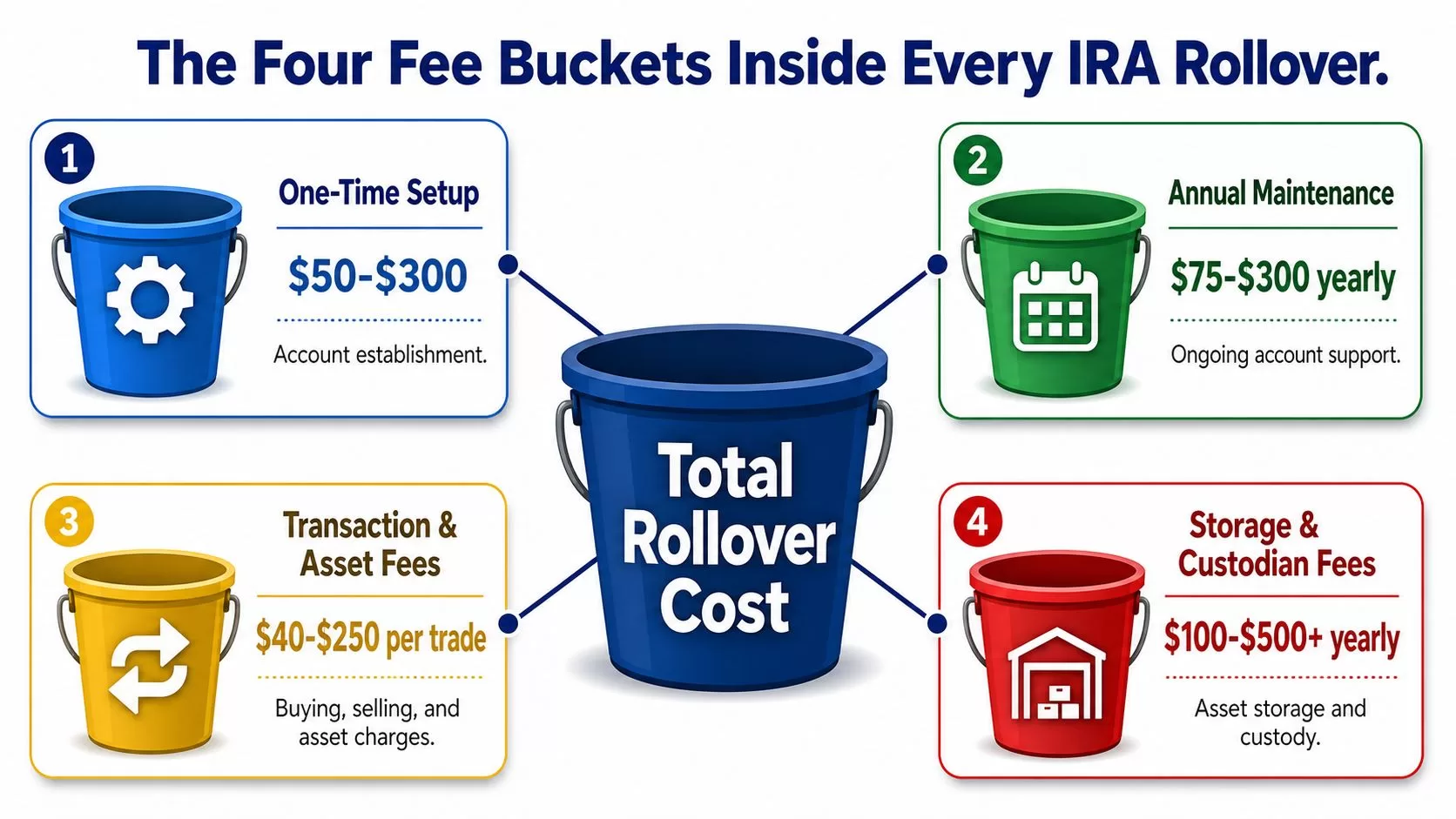
A plain-English way to judge any quote is to separate the bill into four buckets. First is the transfer itself, which is often free on a direct move. Then come the new account's setup and maintenance charges, the storage and custody costs if physical metals are involved, and the transaction costs tied to buying, selling, or wiring money.
If you're comparing offers, don't just ask, “What's the rollover fee?” Ask, “What will I pay in total over 10 to 25 years?” That's the question that exposes whether a move is sensible or just marketed as convenient. For a broader look at how the tax side fits into the move, see IRA rollover tax rules.
How a Rollover Works and Why the Transfer Type Matters
The rollover choice starts with taxes, not fees. A direct trustee-to-trustee rollover moves money from the old account to the new one without you touching the cash. An indirect rollover sends the money to you first and starts the 60-day clock. If you miss that window, the IRS treats the amount as a taxable distribution, which can trigger ordinary income tax and, if you are under 59½, an additional 10% early-withdrawal penalty. See the IRS rollover guidance for the basic rules.
Choose the direct transfer unless you have a specific reason not to. It cuts out withholding problems, deadline mistakes, and paperwork errors. The safest rollover is the one where the money never hits your checking account.
The old employer plan can still add friction. A 401(k) may have distribution rules, may require paperwork before the funds are released, or may charge a termination fee of $25 to $100 (Annuity.org). If you are moving money from an employer plan, ask whether the assets will be sent by check or wire, whether any cash-out is required, and whether the plan charges to close the account.
The transfer type also affects the fee stack that follows. A direct rollover usually keeps the move cleaner, but the receiving IRA can still bring its own setup charge, maintenance fee, storage cost, and transaction costs once the account is open. That is the part people miss, because the rollover event itself can be cheap while the new account structure becomes expensive over time. For the tax side of that decision, review IRA rollover tax rules.
Bottom line: use the direct transfer unless there is a clear reason to do otherwise. It is the cleaner path, and it reduces the number of places money can leak out.
For the mechanics, the IRS rollover overview is the right starting point. IRS rollover guidance
The Four Fee Buckets Inside Every IRA Rollover
The right way to read a rollover quote is to sort every charge into a bucket. Do that first, and the hidden costs stop looking mysterious.
One-Time charges and recurring account costs
A new self-directed IRA can come with an account setup fee and an annual maintenance fee. The setup fee is the opening charge. The maintenance fee is the recurring cost of keeping the account active, handling statements, and administering the structure. Some IRA providers also charge more than $50 per year in maintenance fees, and advisor-managed accounts can run about 0.20% to 0.85% annually.
Those fees matter more than they look on paper because they repeat. If the receiving account is built around advice, brokerage access, or specialty administration, the costs usually follow that setup. A rollover is not just a one-time event, it is a decision about the account you will live with for years.
Storage, custody, and transaction costs
If the IRA holds physical metals, storage fees are part of the deal. Those can be flat charges or value-based charges, and some structures also layer in custodian or administration fees. A transfer into a new tax-advantaged account is usually not the place where the biggest cost shows up. The ongoing account charges are where the main cost lies.
Then there are the smaller items that are easy to miss. Wire transfers can add bank fees, while ACH transfers are often free. Trading costs can also show up if the account buys and sells positions inside the IRA. Even when the rollover itself costs little or nothing, the account can still charge every time money moves in or out.
Practical rule: ask for the fee schedule in writing before the rollover starts, then compare the all-in cost, not just the opening charge.
For a closer look at how account structure affects cost, see Gold IRA comparison basics.
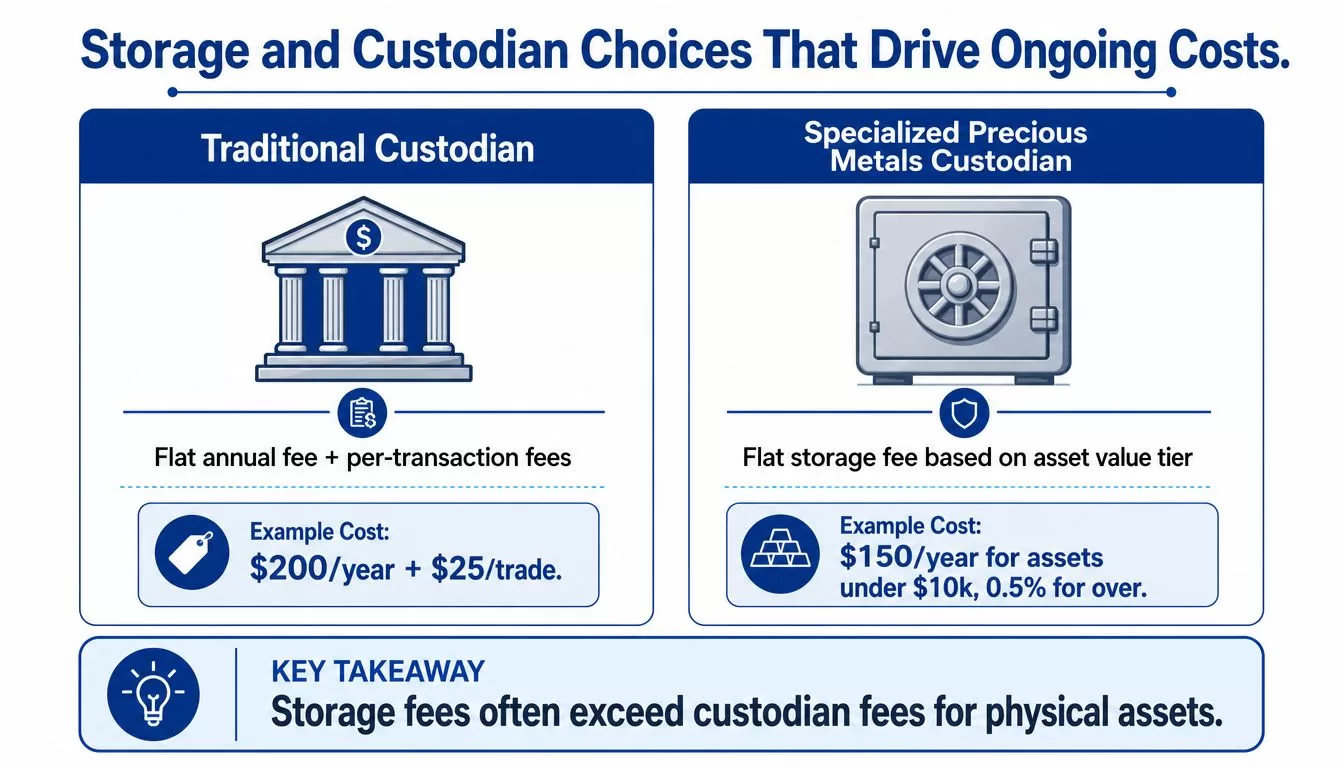
Storage and Custodian Choices That Drive Ongoing Costs
A rollover can look cheap on paper and still cost plenty later if the storage and custodian setup is loaded with ongoing charges. That is the part people miss. The account is not just a landing spot for the money, it becomes the fee engine you live with after the transfer is done.
Flat fees versus value-based fees
A flat-fee setup is the easier bill to predict. You pay the stated amount, and the balance in the account does not change that charge much. A percentage-based structure works differently. As the account grows, the bill rises even if the service stays the same.
That matters most once the balance gets larger and the account stays open for years. A flat charge can be tolerable on a modest account because it stays fixed. A percentage-based storage or administration fee can start small, then take more each year as the account value increases.
Segregated storage versus commingled storage
The storage arrangement also changes the cost. Segregated storage keeps assets reserved for one account. Commingled storage shares space with other holdings of the same type. The choice affects both pricing and how the depository manages the metals.
A hidden trap is a promotional rate that expires. Some accounts start with a waived fee, then reset to the standard charge later. That is fine only if the later charge is plain in writing. If the waiver ends and the regular rate is higher than you expected, the rollover was not cheap, it was just postponed.
A clean pre-rollover review should ask about:
- Storage method: segregated or commingled, and what each one costs.
- Fee basis: flat dollar amount or percentage of assets.
- First-year promotions: whether they expire, and exactly when.
- Sub-account charges: any extra fee tied to each metal type or position.
Ask for every charge in writing. If a custodian will not disclose fees clearly, walk away.
The lesson is plain. Storage and custodian design drive the long-term cost far more than the rollover paperwork itself. For the role of the account holder and the metals custodian, review Gold IRA custodian details.
Two Sample Cost Stacks Over 10 and 20 Years
Numbers make the issue clearer. A rollover that sounds cheap at the start can become expensive if the annual drag is high enough, especially when the fees repeat for years.
| Starting Balance | Annual Drag | 10-Year Fees | 20-Year Fees |
|---|---|---|---|
| $50,000 | 0.20% | Qualitatively low, because the ongoing drag stays modest | Still relatively restrained if the fee structure stays flat |
| $50,000 | 0.85% | Material over time, because the fee repeats every year | Meaningfully higher over two decades |
| $250,000 | 0.20% | Low relative drag, but still a real cost | Higher than the opening quote suggests |
| $250,000 | 0.85% | Much heavier annual burden on a larger balance | The long-run cost becomes hard to ignore |
The point of the table is not to pretend every provider charges the same thing. It's to show that percentage-based costs scale with the balance, while flat charges don't grow the same way. On a smaller account, the difference may feel manageable. On a larger one, the compounding drag is harder to shrug off.
For a 60-year-old deciding whether to roll into a metals IRA, the comparison should be between the receiving account and the alternative. If the rollover adds ongoing storage and custody layers, the new account needs to justify that complexity. If it doesn't, staying put or choosing a simpler IRA structure may be the cheaper route.
The right way to think about this is blunt. A “free rollover” with a steady annual drag can become more expensive than a modest one-time move with low recurring fees. The transfer event is only the doorway. The primary expense is the house you move into.
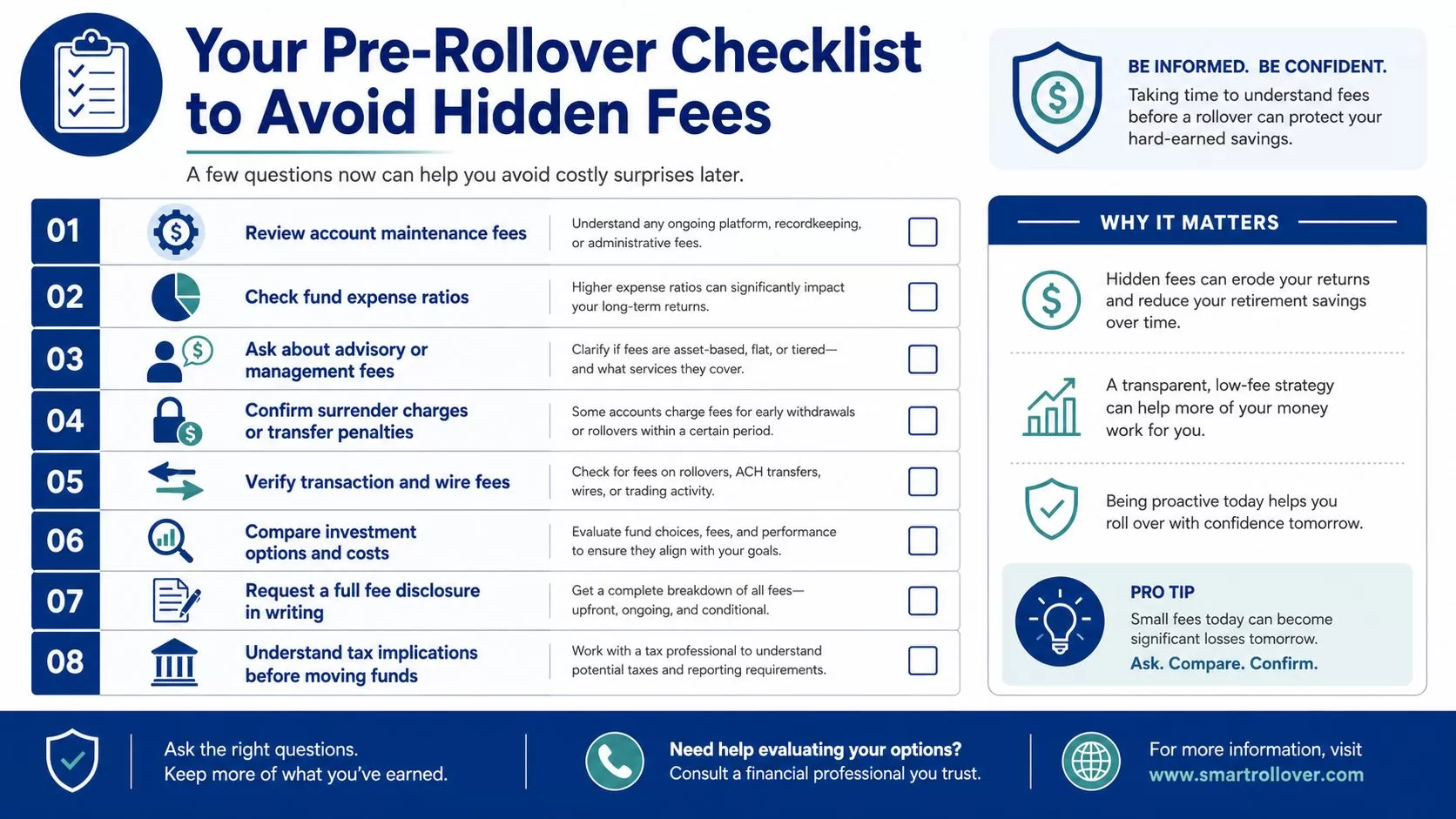
Your Pre-Rollover Checklist to Avoid Hidden Fees
Before any paperwork is signed, get the fee story in writing. That's not paranoid, it's basic discipline.
What to ask for first
- Old plan fees: request the distribution or termination schedule from the current custodian.
- New account fees: get the complete custody, maintenance, storage, and transaction schedule in writing.
- Transfer method: confirm that the move will be direct trustee-to-trustee, not an indirect handoff.
- Storage terms: verify whether the depository uses segregated or commingled storage.
- Wire policy: ask whether bank wires cost money and whether ACH is available without charge.
- Fee waivers: get any first-year promotion or waiver spelled out with an end date.
- Trade costs: confirm buy and sell spreads, commissions, and any per-transaction charge.
The red flags are easy to spot once you know what to look for. A provider that won't put fees in writing is a problem. A same-day pressure pitch is a problem. A “free first year” offer with vague renewal language is a problem too.
Keep one folder with every document, quote, and disclosure. That way, if the bill changes later, the paper trail is already there.
For readers who want to compare account types before making a move, compare Gold IRA company options and ask for a full written fee schedule before anything is signed. If a human walkthrough is easier, call the Gold IRA Association specialist line at 888-910-8386.
Questions Readers Ask After the Main Walkthrough
Is a rollover taxable? A direct rollover between qualified retirement accounts is usually not taxable when it is handled correctly. The trouble starts with an indirect rollover that misses the 60-day deadline, because the distribution can then be taxed as ordinary income.
Can the 10% penalty apply to a rollover? Yes, if the money is treated as a taxable distribution and the account owner is under 59½. That is why the transfer method matters so much, and why a direct transfer is the cleaner move.
Are 401(k) rollovers different from IRA-to-IRA rollovers? They can be. Employer plans may have their own paperwork, timing rules, and possible charges, so the old plan can add its own costs before the new IRA even starts. Direct and indirect rollovers are handled differently, so the path matters as much as the destination.
Are IRA fees tax-deductible? Usually, the ongoing custodian or storage costs inside the IRA are paid from the account itself rather than deducted on a tax return. The tax treatment can vary by situation, so the safe move is to confirm the details with a licensed tax professional.
The Bottom Line and Your Next Step
An IRA rollover is usually cheap at the moment of transfer and expensive only if the receiving account is built that way. The cost comes from the four buckets, setup, maintenance, storage, and transactions, plus any old-plan exit charge.
The best move is straightforward. Get the full fee schedule in writing before the rollover starts, compare the all-in cost over time, and don't let a “free” transfer hide a costly account structure.
This content is for education only, not personalized financial, tax, or legal advice. Rules vary by situation, so a licensed financial advisor, CPA, or attorney should review your specific rollover before you act.
Gold IRA Association publishes plain-English guides, fee breakdowns, and rollover checklists for retirees who want to compare their options without the sales pitch. If you're weighing ira rollover fees and want a calm, organized next step, visit Gold IRA Association to review the guidance and get help deciding what makes sense for your account.