


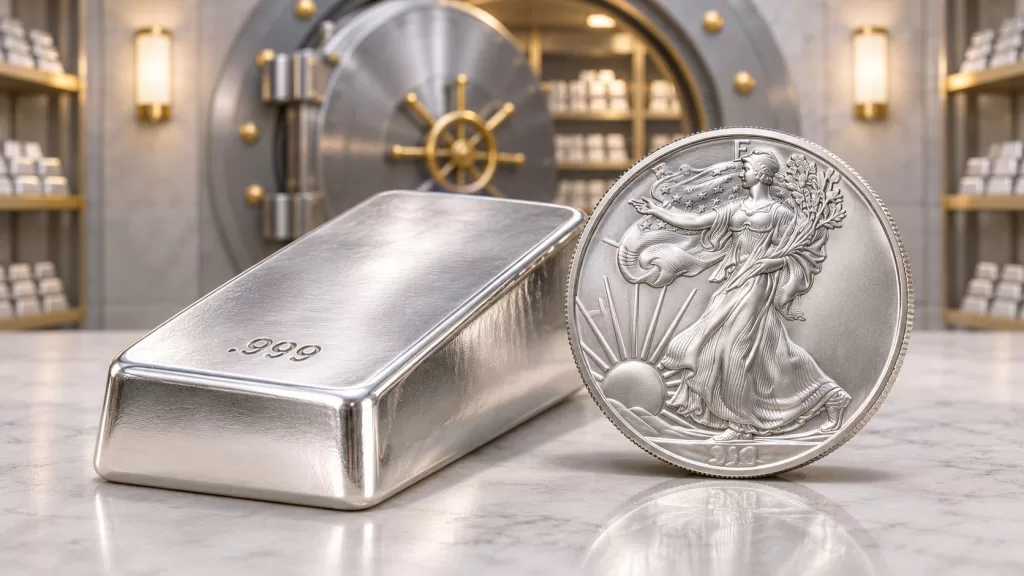
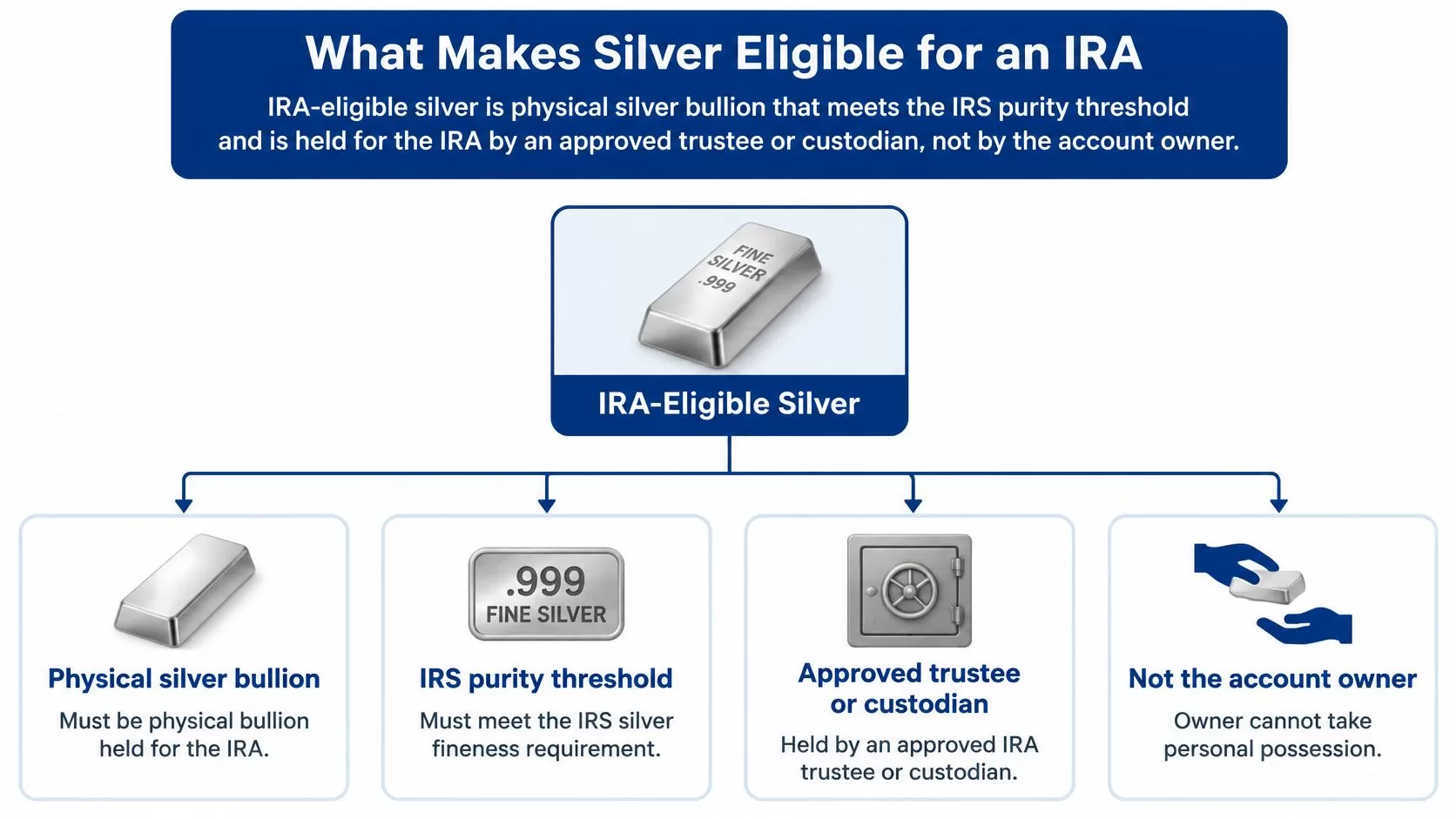
IRA-eligible silver is physical silver bullion at least 99.9% pure that an approved trustee or custodian holds for the IRA, not the account owner. Why do so many retirement savers pass the purity test on a silver bar and still trigger a surprise tax bill? Most buyers assume that once a coin or bar carries a high-purity stamp, the compliance work is finished. Understanding what is IRA eligible silver requires clearing a two-part threshold covering both the physical metal and the custody structure behind it, and knowing how those rules connect protects retirement savings from costly distribution mistakes.
What Makes Silver Eligible for an IRA
Federal retirement law doesn't treat every silver product on the market as a permissible retirement asset. Under IRS guidance on collectibles in individually directed qualified plan accounts, IRAs are generally barred from holding collectibles, yet IRC Section 408(m)(3) carves out a specific exception for qualifying silver bullion. To meet that exception, the silver must have a fineness at least equal to the minimum required for delivery under a regulated futures contract, which in practice means at least 99.9% pure silver (expressed as 999 parts per 1,000), and it must remain in the physical possession of a bank or an approved non-bank trustee.
That same IRS guidance notes that the agency's model traditional IRA document allows certain silver bullion solely under the Section 408(m)(3) exception. If a retirement account acquires silver outside those boundaries, the IRS can treat the purchase as a taxable distribution, potentially triggering ordinary income taxes and early-distribution penalties. In other words, an item isn't eligible just because it's made of silver; eligibility describes both the metal's purity and its custodial arrangement.
The diagram below maps how those core rules fit together for a compliant retirement purchase.
Three Cumulative Tests Every Purchase Must Pass
Every piece of silver bought inside a self-directed Silver IRA has to satisfy three separate requirements at the same time. Failing even one disqualifies the transaction.
- Minimum Fineness Standard: The bullion generally must reach at least 999 parts per 1,000 pure silver. Anything below that purity line falls outside the bullion exception, regardless of how much total metal the item contains.
- Recognized Product Identity: The asset must be a qualifying bullion coin or standardized bar rather than a commemorative issue, specialty strike, or graded collectible. Retail marketing terms don't override federal tax categories.
- Approved Trustee Custody: A bank, approved non-bank trustee, or designated depository must receive and store the silver in the IRA's name. A bar stamped .999 fine still fails federal compliance if the account owner takes it home and locks it in a personal safe.
How Silver Fineness Works and Where the Rule Began
Fineness measures the proportion of pure precious metal in an alloy out of 1,000 parts by weight. Take a straightforward one-ounce worked example: a one-troy-ounce silver bar struck at .999 fineness contains approximately 0.999 troy ounces of pure silver, leaving only a tiny fraction of trace material. Compare that benchmark to familiar household and historic alloys that fall below the line, such as sterling silver flatware at .925 purity or pre-1965 U.S. circulating coinage at .900 purity. Both carry real silver value, yet neither meets the statutory minimum for IRA bullion.
The legal structure behind modern precious metals retirement accounts traces back nearly three decades. As detailed in an IRS private letter ruling on IRA bullion, the Taxpayer Relief Act of 1997 amended IRC Section 408(m) to allow IRAs to invest in certain silver, gold, platinum, and later palladium bullion, provided the metal stayed in an IRA trustee's physical possession. That statute also points to U.S. silver bullion coins defined under 31 U.S.C. Section 5112(e), including one-ounce silver coins minted by the Treasury Department, and cites institutional benchmarks such as London Good Delivery silver bars weighing between 750 and 1,100 troy ounces with a minimum fineness of 999.0 parts per 1,000.
Check the purity hallmark stamped directly on the silver product alongside the refiner's assay certificate, and verify current IRS thresholds with your custodian before authorizing any purchase.
Because statutory interpretations and custodian acceptance lists can shift over time, checking the hallmark and matching paperwork against current IRS guidance remains an essential first step before committing retirement funds.
Which Silver Coins and Bars Qualify
Use the comparison table below as a starting filter for common retail products, keeping in mind that your self-directed IRA custodian makes the final acceptance call on every individual coin or bar before you buy.
| Product | Typical fineness | IRA eligible? | Key note |
|---|---|---|---|
| American Silver Eagle (1 oz) | .999 | Generally eligible | Treasury-minted bullion coin; confirm the bullion version, not proof |
| Canadian Silver Maple Leaf (1 oz) | .9999 | Generally accepted by custodians | Exceeds the .999 minimum; confirm with custodian |
| 1 oz silver bars from approved refiners | .999 or higher | Eligible if on custodian's approved list | Check refiner, assay and serial documentation |
| Silver rounds from private mints | Often .999, set by private mint | Generally not eligible | Not government-issued bullion; custodians often decline |
| Proof or commemorative silver coins | Set by each mint issue | Generally not eligible | Collectible value drives price; collectible rules apply |
| Numismatic or collectible coins | Set by historic coin alloy | Not eligible | Collectible rules apply regardless of silver content |
| Pre-1965 U.S. junk silver | .900 | Not eligible | Below the .999 minimum fineness |
Sovereign Bullion Coins and Approved Refiner Bars
Federal tax rules treat official government bullion coins differently from private-mint items. Specifically, IRS Publication 590-B lists one-ounce silver coins minted by the U.S. Treasury among the investments an IRA can hold, while separately permitting certain gold, silver, palladium, and platinum bullion. That explicit statutory mention is why the standard bullion American Silver Eagle sits on clear ground for retirement accounts, provided the trade confirmation specifies the standard bullion strike rather than a specialty edition.
High-purity sovereign coins from outside the United States also appear on most custodian lists. The Canadian Silver Maple Leaf, struck at .9999 fineness, clears the minimum purity requirement with room to spare and is commonly accepted by self-directed custodians, though buyers should still request written confirmation before ordering. Standardized one-ounce bars and larger ingots also qualify when they meet fineness rules, carry serial numbers and assay documentation, and come from a refiner the custodian recognizes. Investors weighing bar formats against coins can review how IRA-approved silver bars are screened for refinery accreditation and weight standards.
Why Popular Silver Products Fall Outside the Rules
Many widely advertised retail silver items look compliant at a glance yet fail custodian screening. Private-mint silver rounds often mirror coin dimensions and may carry a .999 stamp, but they aren't government-issued legal tender and many custodians decline them unless the producing mint meets strict accreditation rules.
Proof, commemorative, and numismatic coins trigger a different problem. Buyers pay steep markups for limited mintages, mirror finishes, or third-party grading slabs, which places those items under collectible restrictions even when they contain substantial silver. Pre-1965 U.S. junk silver misses on metallurgy alone because 90% silver coinage falls short of the bullion fineness floor.
A retail webpage labeling an item as investment silver doesn't make it compliant under the Internal Revenue Code. Always verify the exact product name, weight, mint or refiner, and current custodian acceptance policies against up-to-date IRS rules before placing an order.
Verify Custody and Avoid Compliance Pitfalls
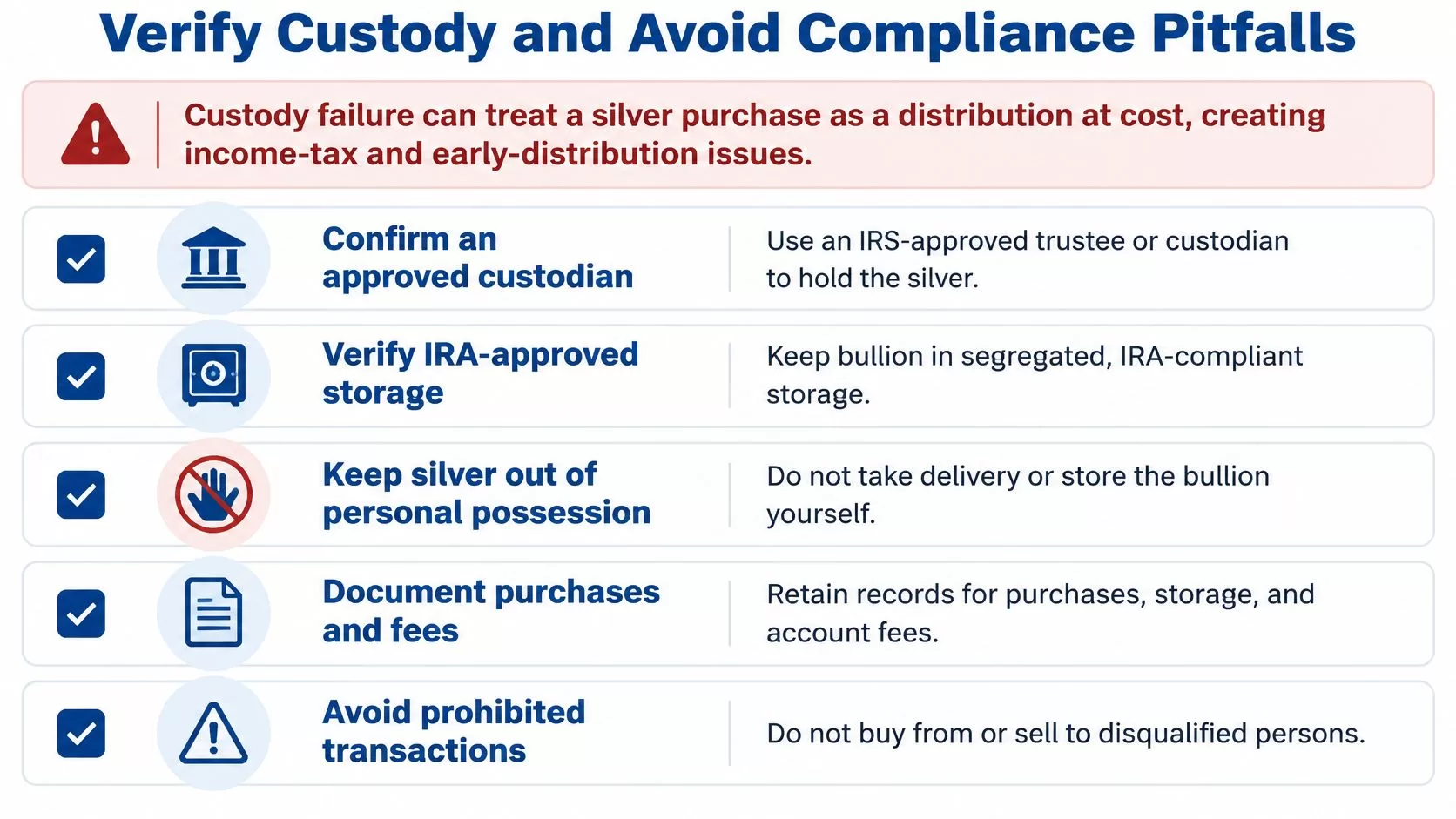
The costliest mistake in a precious metals retirement account rarely happens over a small pricing disagreement with a dealer. It happens when a buyer acquires an ineligible product or breaks the custody chain. According to IRS Publication 590-A, acquiring a collectible through an individually directed qualified account is generally treated as an immediate distribution equal to the item's cost, and personally storing bullion instead of leaving it in a bank or approved trustee's physical possession can trigger that exact distribution consequence.
Once a transaction is reclassified as a distribution, the account owner may owe ordinary income tax on the full purchase cost plus potential early-distribution penalties if under the applicable retirement age. Running a structured check before money leaves the IRA is the simplest way to keep custody airtight.
The checklist infographic below summarizes the custody guardrails every self-directed IRA owner should confirm before funding a silver purchase.
Six Verification Steps to Run Before Any Purchase
Follow this sequence with your custodian before signing a trade authorization:
- Confirm the account structure and depository. Verify that the retirement account is a self-directed IRA whose custodian administers physical precious metals and names an IRS-approved depository. Conventional brokerage IRAs don't hold physical bullion, so attempting to route a metals purchase through a standard account will stall immediately.
- Secure written product confirmation. Before wiring funds, ask the custodian to confirm the exact coin or bar name, troy-ounce weight, fineness, and mint or refiner in writing. If a dealer suggests swapping in a different coin because of inventory shortages, stop and get the substitute approved in writing too.
- Verify legal title and vault custody. Confirm that the trustee and depository will hold the silver strictly in the IRA's name with no personal possession by the account owner. Reviewing how precious metals storage operates inside insured vaults helps clarify whether the account uses segregated or commingled holdings under trustee oversight.
- Collect and retain full documentation. Keep copies of trade confirmations, refiner assay certificates, and depository receiving receipts alongside your IRA statements. Complete records prove that the exact metal approved on paper is what entered the vault.
- Ask how future sales and withdrawals work. Find out ahead of time how the custodian handles liquidation for cash or in-kind physical distributions, including processing timelines and shipping rules. Knowing the exit path prevents surprises when retirement withdrawals begin.
- Compare the published fee schedule. Request the custodian's written fee schedule covering account setup, annual administration, depository storage, and buy-or-sell transaction charges rather than relying on informal verbal estimates.
Documentation rule: Ask for written product approval and published fee schedules before authorizing a trade, because reversing a non-compliant shipment after delivery is far more complicated than catching an error upfront.
Common Silver IRA Mistakes and How to Prevent Them
Custodians routinely reject incoming bullion shipments when assay records are missing or the delivered product doesn't match the written trade ticket. During compliance reviews, auditors examine exact product identity and proof of trustee custody rather than marketing claims from a dealer brochure.
| Mistake | Why it causes trouble | Fix |
|---|---|---|
| Storing silver at home | Owner possession falls outside the trustee custody exception | Use an approved trustee or depository |
| Buying proof or commemorative coins | Collectibles fall outside the bullion exception | Request bullion-only products by name |
| Trusting a "silver" label | Retail labeling does not control IRA treatment | Verify product identity with the custodian |
| Choosing sub-.999 silver | Below the minimum fineness standard | Check hallmarks and assay certificates |
| Buying from unapproved sellers | Custodian may reject the purchase or documentation | Use dealers the custodian has approved |
Most errors in the table above happen when buyers assume dealer convenience equals tax compliance. Requesting written verification from the custodian before placing an order catches nearly every one of these pitfalls ahead of time. Remember that retirement tax rules vary by individual circumstances, so this checklist supports clean recordkeeping without replacing personalized guidance from a licensed tax professional or financial advisor.
What IRA Eligibility Does Not Guarantee
Passing every federal purity and custody rule answers only a tax-treatment question. It doesn't turn physical silver into a low-risk retirement asset, nor does it guarantee that silver fits a particular saver's time horizon or income needs.
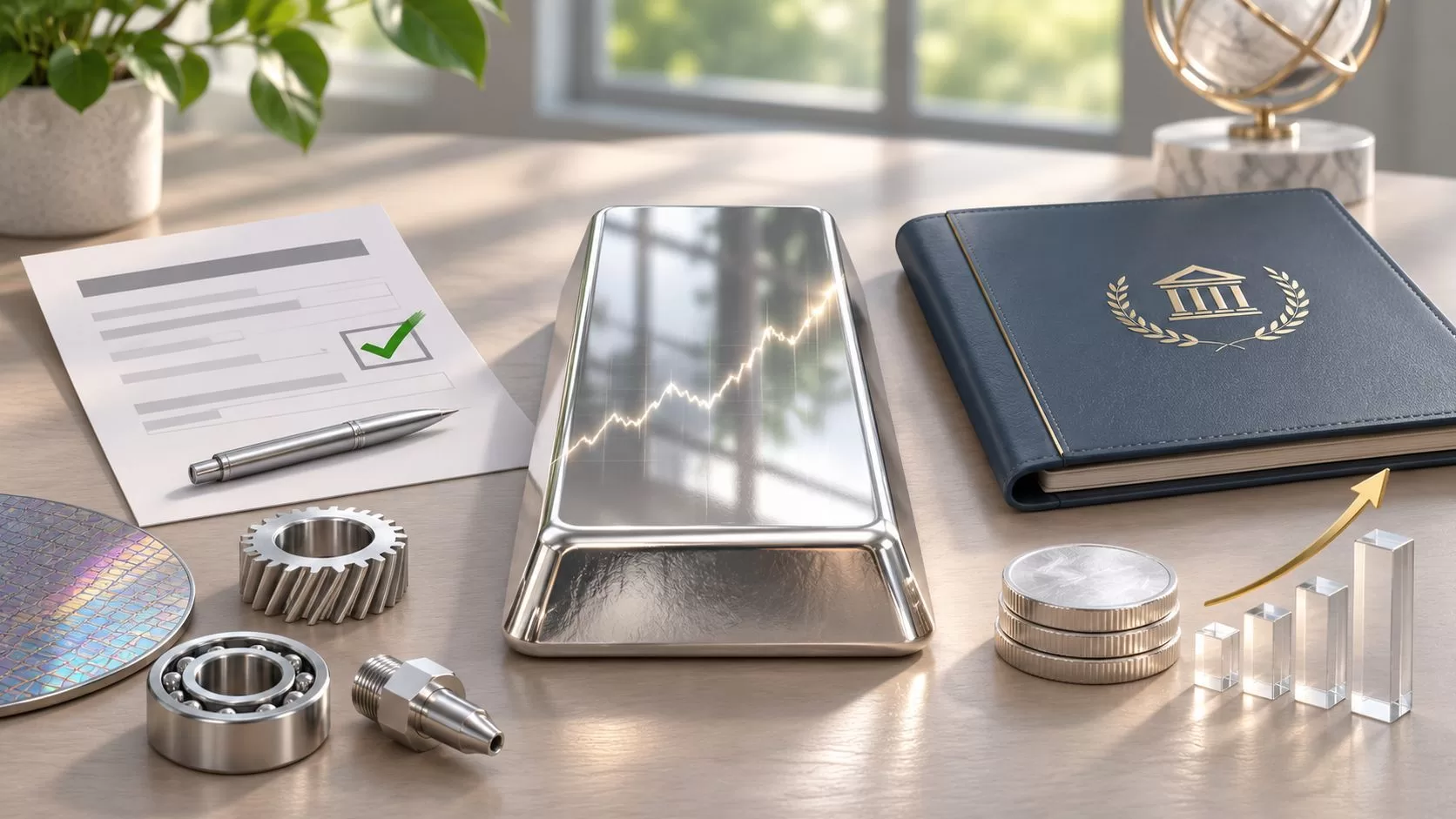
Unlike gold, which trades predominantly as a monetary store of value, silver responds to both investor demand and global factory output. That dual identity makes its price behavior more complex than simple headlines suggest.
Industrial Demand Cycles and Price Volatility
Market figures from the World Silver Survey 2026 by the Silver Institute show why industrial narratives can cut both ways. Industrial silver demand declined 3% to 657.4 million ounces in 2025, and forecasts project it to fall again to roughly 639.6 million ounces in 2026, even as AI infrastructure, automotive electronics, and power-grid upgrades support longer-term consumption. At the same time, forecasts still project a sixth consecutive global market deficit in 2026, with estimates near 46.3 million ounces as both total demand and total supply are projected down 2%.
A projected supply deficit doesn't automatically translate into rising prices. Tighter supply can help support valuations, yet slower manufacturing, industrial substitution toward cheaper metals, and expanded recycling can offset that upward pressure. On top of market swings, silver has historically been more volatile than gold, and physical IRA owners still face dealer premiums at purchase, annual depository storage charges, and bid-ask spreads when selling.
The video below explains how investors evaluate physical precious metals within a diversified retirement plan and what trade-offs matter beyond basic tax eligibility.
Required Minimum Distributions and Retirement Liquidity
Owning physical metal inside a traditional retirement account doesn't pause mandatory withdrawal rules. Under IRS required minimum distribution rules, owners of traditional, SEP, and SIMPLE IRAs generally must start taking RMDs at age 73, with the first distribution generally due by April 1 of the year following the year they turn 73 and later annual withdrawals due by December 31, even if they're still working.
Because bars and coins aren't liquid cash, meeting an RMD often requires the custodian to sell enough silver to cover the required dollar amount or distribute physical metal in kind. Roth IRAs follow different rules during the original owner's lifetime, making account type a major factor in withdrawal planning. Investing in precious metals and IRAs involves risk, including the potential loss of principal.
Frequently Asked Questions About IRA Silver
Can I Put Silver I Already Own Into My IRA
No, and this surprises many first-time buyers. Retirement accounts accept cash contributions, so even a bar that easily passes the purity test cannot be handed over to the account. The metal must be purchased with IRA funds through the custodian and shipped straight to the depository. A well-meaning owner who already holds qualifying bullion at home has passed the first test of metal but cannot satisfy the second test of custody and purchase path. The practical route is to keep existing silver as a personal holding or sell it, then fund the IRA separately and let the custodian execute the new purchase.
Are American Silver Eagles IRA Eligible
Generally yes, when the purchase documents clearly specify the standard Treasury-minted bullion version. The confusion arises because the same design exists in collectible forms. A proof, graded, or specially finished Eagle can fail the product classification test even though its metal content matches the bullion version exactly. Because custodians enforce their own acceptance lists and documentation standards, get written confirmation on the exact coin before placing an order.
What Happens to a Silver IRA When the Owner Dies
The account passes to the named beneficiaries, and the metal inside it follows retirement inheritance rules rather than the rules for personal property. A surviving spouse generally has more flexibility than other heirs, including the option to treat the account as their own, while non-spouse beneficiaries typically face a timeline for emptying the account. Distributions can be taken as cash after a sale or as physical metal in kind, with the distributed value generally treated as taxable income for traditional accounts. Because the details depend on the relationship, the account type, and current IRS rules, beneficiaries should confirm their options with the custodian before touching the metal.
Can I Move My Silver IRA to a Different Custodian
Yes. A direct trustee-to-trustee transfer moves the account without the owner taking possession of anything, so the silver typically travels from one approved depository to another or changes registration while staying in the same vault. The key precaution is the same custody test in a new setting: the metal must never pass through the owner's hands during the move, and the receiving custodian must accept the specific coins and bars already in the account. Confirming both points in writing before initiating the transfer avoids an interrupted chain of custody that could be treated as a distribution.
Confirm Eligibility With a Custodian Before You Buy
Evaluating physical silver for a retirement account comes down to verifying three connected checkpoints before any money moves:
- Fineness: Bullion meeting or exceeding the IRS purity benchmark rather than sterling or lower-grade silver alloys.
- Product Classification: A recognized bullion coin or approved refiner bar instead of a collectible, proof, or commemorative coin.
- Custody: Direct delivery to an approved trustee or depository in the IRA's legal name, with zero personal storage by the owner.
The safest next step is speaking with a self-directed custodian before buying, because the custodian's written product confirmation is the record that protects the account before a trade settles. Savers weighing how physical silver's volatility compares with stocks, bonds, or cash across retirement vehicles can also compare super investment options by risk using Wealth Collective's guide to frame how different asset classes balance growth and downside risk.
Pre-trade checkpoint: Keep the custodian's written product approval and published fee schedule on file before funding any metals purchase.
Gold IRA Association's team offers personalized advice suited to an individual's retirement goals and financial situation, and readers who want to talk with a Gold IRA specialist can call 888-910-8386. Even so, Gold IRA Association operates as an educational resource rather than a financial advisor, CPA, or attorney. The materials on Gold IRA Association's website are provided for informational purposes only and are not intended as financial, legal, or investment advice. This is not financial advice. Consult a licensed financial advisor, CPA, or tax professional before making investment decisions. Because federal rules and custodian policies vary by individual circumstances, verify every eligibility detail against current IRS guidance before placing an order.
Take the next step toward a compliant precious metals retirement account by exploring the guides and provider comparisons at Gold IRA Association. You can review step-by-step rollover instructions, examine custodian and storage fee structures, and compare top Gold IRA companies side by side before requesting written silver eligibility confirmation from your chosen custodian.