




Which matters more in a silver IRA, the lower price paid today or the cost of turning that silver back into retirement income later? Most comparisons answer only the first question. That's a mistake. Silver coins and silver bars can have very different premiums, resale spreads, verification requirements, storage characteristics, and withdrawal flexibility, so the cheaper purchase isn't automatically the cheaper retirement asset.
For most near-retirees, the practical choice is straightforward. Use recognized coins when staged withdrawals and easy resale matter most. Use bars when long-term accumulation and lower acquisition premiums clearly outweigh the loss of divisibility. The right answer depends on how the IRA will be used, not on which product looks more attractive in a dealer's catalog.
Why the Silver Form Factor Matters for Your IRA
A self-directed IRA holding physical silver isn't the same as buying a few pieces for a personal safe. The account has rules, a custodian, an approved depository, transaction costs, and eventually a distribution process. The form of silver affects every part of that chain.
A coin usually gives a retiree smaller, more recognizable units. That matters when distributions occur gradually. A bar can provide more silver for the purchase price, particularly in larger sizes, but it may force the account owner to sell a larger block than needed. The decision becomes more important as retirement approaches, because flexibility can matter more than maximizing ounces.
Readers evaluating silver coins as an investment should separate five questions:
- Eligibility: Does the product meet the applicable purity and sourcing requirements?
- Acquisition cost: How far above the spot price is the purchase premium?
- Exit cost: What will the dealer or market maker pay when the IRA sells?
- Logistics: How will the custodian store, insure, assay, and record the metal?
- Tax treatment: How will distributions be handled under the account owner's circumstances?
Practical rule: A silver product belongs in a retirement account only after the account owner understands both the purchase transaction and the eventual sale transaction.
The market's long-term behavior also shows why no single format suits everyone. From 2010 to 2024, investors bought more than 514 million ounces of silver bars and coins globally, while physical silver investment reached 59.8 million ounces in 2024, equal to 30% of global retail investment, the highest share since the series began, according to Silver Institute market data. Those figures describe a broad market with different needs, not a universal recommendation.
For a near-retiree, the central question is simple: Will the IRA need maximum metal exposure, or will it need dependable partial liquidation? Bars usually serve the first objective. Coins usually serve the second.
IRS Eligibility Rules for Silver Coins and Bars
Can a lower-cost silver bar enter your IRA, or will a compliance mistake turn the purchase into a distribution? Check eligibility before comparing premiums. Silver held in a self-directed IRA generally must meet a minimum fineness of.999, meaning the metal must be at least 99.9% pure, according to the IRS-approved silver guidance for self-directed IRAs. The rule applies to coins and bars alike.
Bars require another layer of review. IRA silver bars typically need to come from accredited refiners, including facilities approved by recognized market organizations such as LBMA or COMEX. Size alone does not make a bar acceptable. The issuer, refiner, purity, documentation, and custodian's approval all affect eligibility.
Commonly recognized government bullion coins can qualify when they meet the applicable standards. American Silver Eagles and Canadian Maple Leafs are examples of widely accepted products discussed in guidance on buying silver for an IRA. The key distinction is bullion versus collectible or numismatic silver.
Bullion status matters more than appearance
A government-minted coin is not automatically IRA-eligible because it has an official design or legal-tender denomination. Collectible coins can be excluded even when they contain silver. Their value may depend on rarity, condition, historical appeal, or collector demand instead of the account's bullion requirements.
Ask the custodian to confirm these points before placing an order:
- Purity: Does the product meet the required.999 fineness standard?
- Source: Does the bar come from an approved refiner?
- Product type: Is it bullion rather than an excluded collectible?
- Documentation: Will the custodian accept the product's assay and provenance?
- Storage: Will the metal move directly into an approved third-party depository?
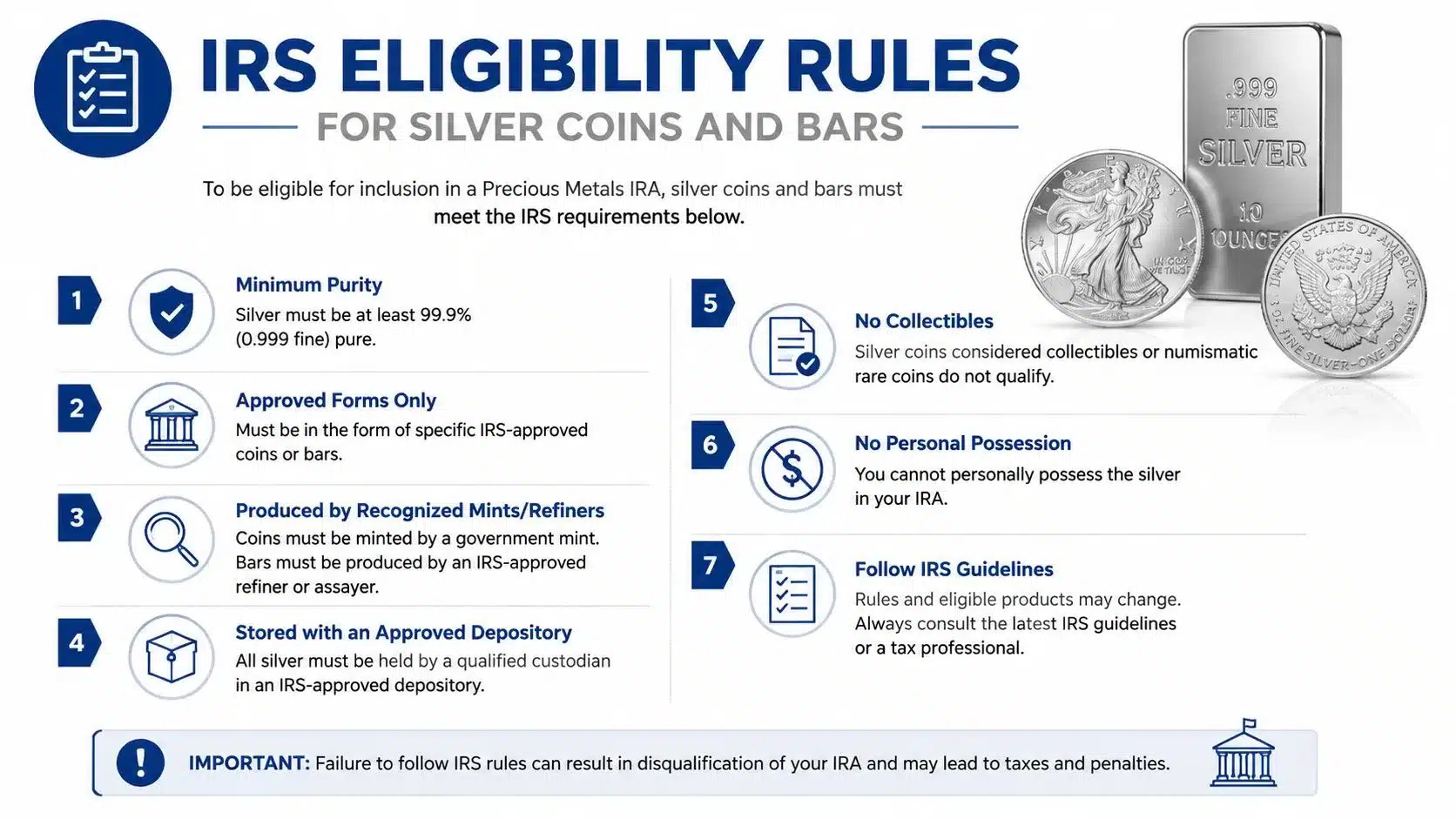

Use the custodian's approved product list, not assumptions based on a coin's appearance or a bar's advertised weight. Buying a non-qualifying product first and asking questions later can create a distribution problem, with tax consequences that depend on the account owner's circumstances.
Personal possession and IRA ownership also follow different rules. Physical silver purchased for an IRA generally must remain within the custody and storage arrangement required for the account. Before money changes hands, the custodian, dealer, and depository should confirm the ownership chain, documentation, and delivery process. Eligibility comes first. Only then should acquisition cost enter the comparison.
Comparing Premiums and Acquisition Costs
Bars are usually cheaper to acquire per ounce. That advantage comes from simpler production, fewer design features, less distribution complexity, and the absence of the same legal-tender recognition associated with sovereign coins.
The available market ranges make the difference clear:
| Product Type | Typical Premium Over Spot | Key Cost Drivers |
|---|---|---|
| Sovereign 1 oz silver coins | 12% to 25% | Minting, legal-tender recognition, security features, distribution, and resale convenience |
| 10 oz silver bars | 5% to 9% | Fabrication and distribution, with efficiencies from larger units |
| 100 oz silver bars | 3% to 6% | Lower fabrication cost and high weight efficiency |
These ranges come from market data comparing silver coins and bars. They aren't permanent price tags. Dealer inventory, product demand, market conditions, and the specific brand or refiner can change the premium available on a given day.
What the premium buys
A coin's premium pays for more than silver weight. It can include government minting, legal-tender status, recognizable design, packaging, security features, and the convenience of selling a familiar one-ounce unit. That convenience can be useful for a retiree who wants to liquidate a portion of the account without selling a large block.
A bar's lower premium directs more of the purchase price toward metal content. For an investor accumulating over a long holding period, that can be a meaningful advantage. A 100-ounce bar generally offers greater allocation efficiency than a one-ounce sovereign coin, but the investor accepts less flexibility in exchange.
The lowest purchase premium is only a benefit if the investor can eventually sell the product at a reasonable spread and in a size that matches the withdrawal need.
A retirement investor should compare the all-in acquisition price, not just the advertised premium. The review should include the spot reference, dealer markup, shipping if applicable, account transaction charges, and any custodial costs disclosed before purchase.
The key calculation is conceptual rather than complicated:
Net silver efficiency = silver acquired after all purchase costs, not the product's quoted price alone.
Bars generally win that calculation at purchase. Coins may regain ground at sale if they attract more buyers, require less verification, or can be sold in smaller quantities. That's why a premium comparison is necessary but incomplete.
The Hidden Round-Trip Cost of Buying and Selling
The apparent bargain in bars can disappear during liquidation. A buyer may pay less above spot for a bar, then encounter a wider resale spread, extra testing, or a smaller pool of willing buyers. Those costs matter especially when the IRA owner needs several modest distributions instead of one large sale.
Recent market coverage reports 1 oz silver bars selling at about 3% to 10% over spot, while popular government coins such as American Silver Eagles can run about 15% to 25% over spot on the purchase side, according to coverage of silver coins, bars, and resale friction. Those figures show the entry-price advantage. They don't guarantee that the same relationship will hold when the IRA sells.
A dealer may verify a bar more carefully because the bar's recognition depends heavily on the refiner, serial information, assay documentation, condition, and testing results. A widely recognized government coin can be easier for a dealer to identify and resell, particularly when the buyer wants individual units.
How the exit changes the calculation
Consider two retirement strategies:
- Large, infrequent liquidation: An account owner sells a substantial holding in a single transaction. Larger bars may work well because the sale size matches the unit size and the account owner can negotiate around the product's bulk.
- Staged retirement withdrawals: An account owner sells only what's needed for periodic income. One-ounce coins or smaller bars provide more control because the owner doesn't have to dispose of a large unit to raise a smaller amount of cash.
Bars can also receive lower dealer buy-back prices. One source reports bars sometimes quoted 2% to 5% below retail on repurchase, compared with 1% to 3% below retail for government coins, as described in silver IRA coin and bar resale guidance. The quoted difference is not a prediction for every transaction, but it highlights the cost that purchase-only comparisons omit.
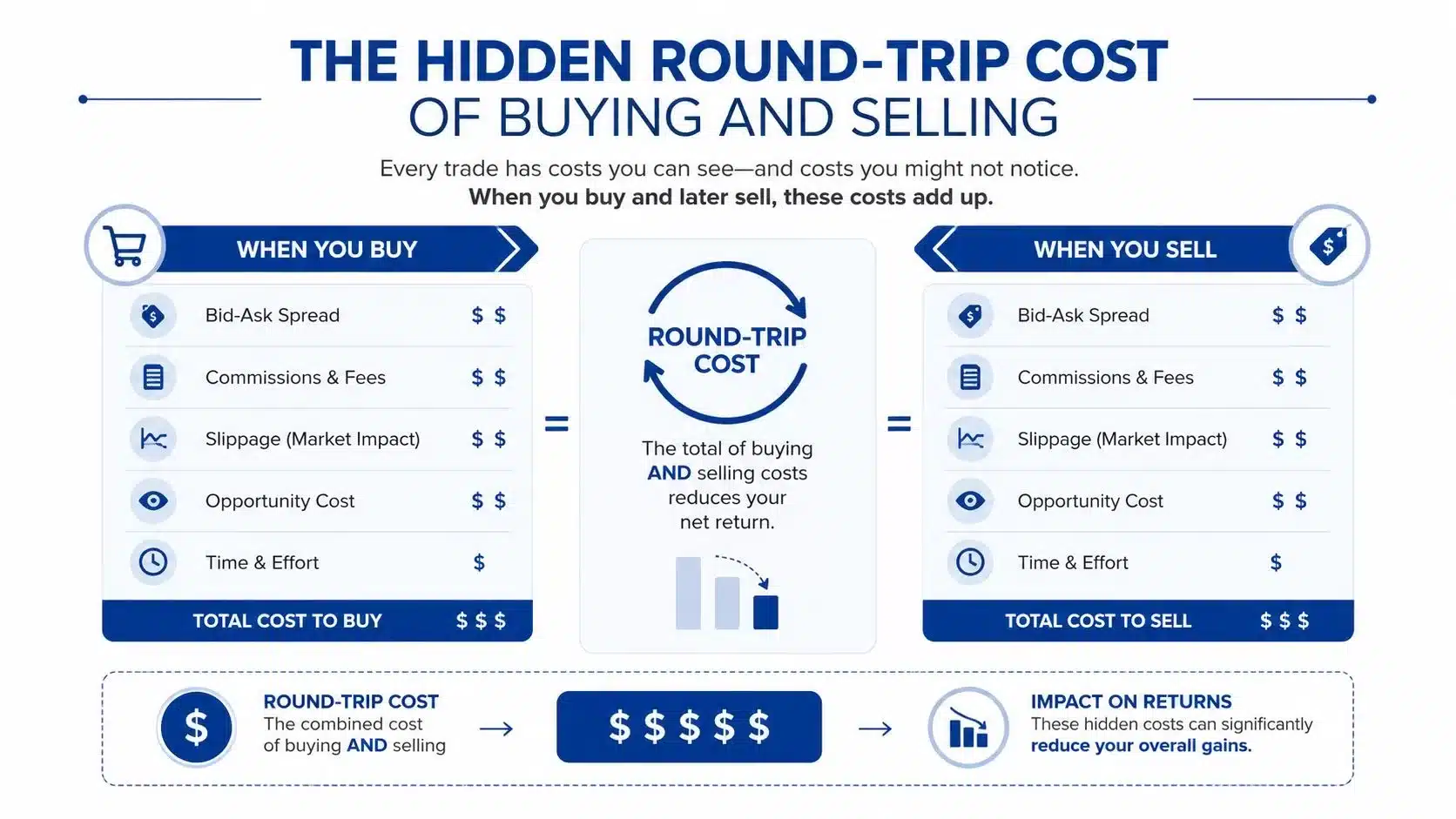
The correct comparison is therefore a round-trip review:
- Purchase premium over spot
- Custodian and depository transaction charges
- Verification or assay friction
- Dealer buy-back price
- Spread between the sale quote and the prevailing spot price
- Size of the liquidation tranche
A bar that saves money on entry may still be the wrong choice if its eventual sale requires more time, more testing, or a larger transaction than the retiree wants. Before choosing bars, the account owner should ask the dealer and custodian how that exact product is bought back, not merely how it is sold.
Storage Density and Custodial Implications
How much shelf space will the same silver allocation require, and how will the custodian charge for it? A larger bar holds more ounces in fewer units, while an equivalent holding of small coins creates more pieces to count, inspect, label, and reconcile. That difference affects vault organization, handling, insurance administration, and possibly the account's total cost.
Manufacturer specifications show a wide physical range. Silver bars can measure roughly 31 x 18 x 2.0 millimeters for 20-gram bars and about 235 x 100 x 75 millimeters for 15,000-gram bars, according to silver bar specifications from a precious-metals manufacturer. Weight, footprint, packaging, assay documentation, and inventory controls all matter more as the holding grows.

Density is useful, but concentration has a cost
Large bars use vault space efficiently and may lower storage costs per ounce, depending on the custodian's fee schedule. Fewer units also mean less counting, inspection, and recordkeeping.
The apparent saving can disappear during the full round trip. A bar may carry a lower purchase premium, yet its sale can involve a wider dealer spread, additional verification, or assay friction before a buyer accepts it. Those costs affect the retirement account even when the bar remains untouched in storage.
Concentration creates another trade-off. One large bar places more value in a single item and limits partial liquidation. Coins divide the holding into many units, but require more packaging and inventory work. The better choice depends on whether storage efficiency outweighs verification and sale flexibility.
Before opening or changing the account, ask the custodian:
- Storage model: Will the silver be segregated or held in a commingled arrangement?
- Fee basis: Are charges based on value, weight, item count, or account service?
- Handling: Does the custodian charge for transfers, audits, or physical verification?
- Insurance: What coverage applies, and are there limits tied to the storage arrangement?
- Liquidation: Can the custodian sell individual coins or partial bar holdings?
A guide to the size of a 10 oz silver bar helps investors visualize the compromise between compact storage and manageable unit size. Medium bars may suit an account that needs better density without committing every ounce to a single large piece.
Custodial costs vary by provider and account structure. Compare storage, insurance, processing, verification, and liquidation charges across the expected holding period. Do not assume that bars produce lower total fees just because they occupy less space.
The video below offers another visual explanation of physical storage considerations.

Liquidity and Resale Considerations for Retirees
Liquidity isn't an abstract benefit for someone approaching retirement. It determines how easily an account can produce cash when a distribution, rebalance, or unexpected expense requires action.
Widely recognized government coins, including American Silver Eagles and Canadian Maple Leafs, are generally easier to liquidate than bars because dealers and buyers already understand the product. A bar can still be liquid, but its resale experience depends more heavily on size, refiner reputation, assay documentation, condition, and the buyer's testing process.
That difference favors coins for investors who expect to sell in smaller tranches. A one-ounce coin lets the owner match the liquidation to the cash need more closely. A large bar may require selling more silver than the distribution requires, or finding a buyer willing to purchase a substantial unit.
Match the form to the retirement stage
A near-retiree with limited time before withdrawals should prioritize recognition and divisibility. The higher purchase premium may be acceptable if the account owner values easier resale and wants to avoid liquidating oversized units.
An investor with a longer horizon and no expected need for partial sales can place more emphasis on premium efficiency. Smaller bars may offer a middle ground, while larger bars make more sense only when the investor accepts less granular access to the holding.
Global demand patterns reinforce the point that preferences differ by market. The United States, India, Germany, and Australia account for about 80% of global physical silver investment, while India represented about 55% of the market from 2010 to 2024 and Australian physical retail investment was 80% to 85% bar-oriented, according to Silver Institute market analysis. Different tax systems, storage practices, investor habits, and liquidity needs help explain those regional preferences.

A practical resale checklist
Before committing retirement funds, the investor should obtain written answers to three questions:
- Who buys the product back? Confirm whether the dealer, custodian, or another market participant handles liquidation.
- How is the quote calculated? Ask whether the offer references spot, retail pricing, a published buy-back schedule, or a negotiated quote.
- What happens to partial holdings? Confirm whether individual coins, smaller bars, or fractional interests in a larger holding can be sold.
The recommendation is direct. Choose coins when liquidity is a primary retirement requirement. Choose bars when the investor can tolerate larger liquidation units and has verified the exit process in advance.
Choosing the Right Silver Form for Your Retirement Goals
The best answer to silver coins vs silver bars depends on the job the silver must perform inside the IRA. A retirement saver should choose the format after identifying the expected holding period, likely distribution pattern, and tolerance for resale friction.
For the long-term accumulator
Bars are the stronger default when the investor's priority is acquiring the most silver exposure for the purchase budget and holding it for a long period. A mix of medium and larger bars can preserve some flexibility without paying the highest premium on every ounce.
Large bars should be used selectively. They're efficient, but they concentrate value and can make partial liquidation difficult.
For the near-retiree
Coins deserve priority when withdrawals may begin soon or when the account owner expects to sell in stages. Recognized one-ounce government coins provide more granular control and may be easier for dealers to verify and resell.
The extra acquisition premium is the price of flexibility. It isn't automatically wasteful if the alternative is selling more silver than needed or accepting a difficult buy-back quote.
For a diversified precious-metals allocation
Silver shouldn't be evaluated in isolation from the rest of the retirement portfolio. An investor already holding other precious metals may use bars for efficient silver exposure while reserving coins for the portion intended to support flexible withdrawals.
The allocation should remain consistent with the investor's broader risk capacity, income plan, tax situation, and need for liquidity. Precious metals can diversify a portfolio, but they don't guarantee income or protect against every investment loss.
For an estate plan
Coins may simplify distribution among heirs because individual units can be identified and divided more easily. Bars can work for an estate intended to remain consolidated, but the plan should address valuation, authentication, storage records, and the process for selling or transferring the metal.
The final due diligence should include the product's eligibility, premium, storage terms, buy-back procedure, and tax treatment. This is not financial advice. Consult a licensed financial advisor, CPA, or tax professional before making investment decisions.
Gold IRA Association provides educational material about silver IRA eligibility, custodians, storage, rollovers, and provider comparisons. Visit Gold IRA Association to review the silver IRA resources before selecting a product or account structure.


