



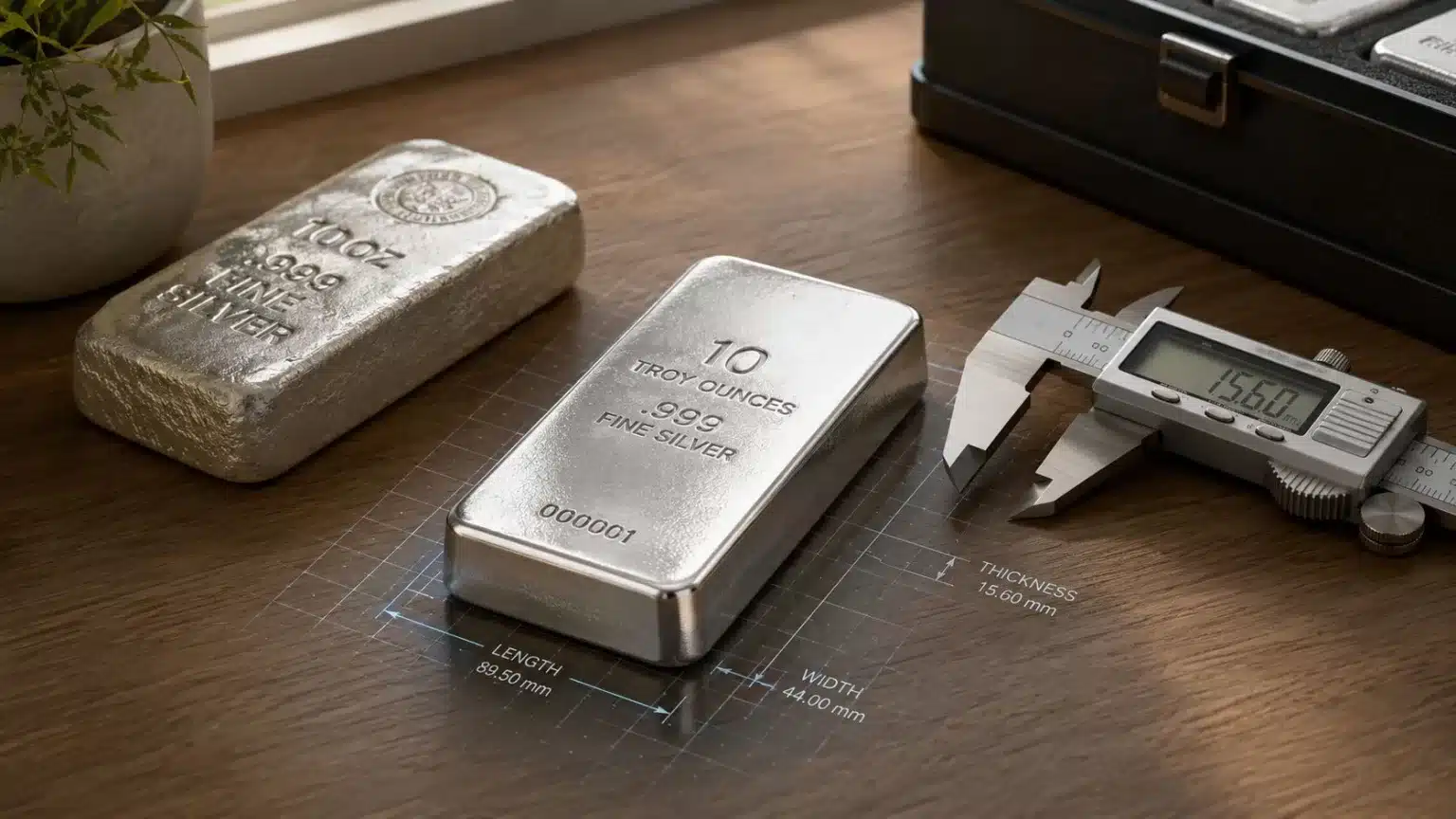
Could two 10 oz silver bars weigh the same yet fail to fit in the same storage tray? Yes. The size of a 10 oz silver bar describes a weight category, not one universal shape. Length, width, thickness, manufacturing method, packaging, and maker specifications all affect how the bar fits into a safe, vault tray, or retirement-account inventory system.
Why 10 oz Silver Bars Vary in Size
Have you assumed that every 10 oz silver bar will occupy the same space? That assumption can complicate storage planning and retirement-account records. The label 10 oz identifies the silver weight, not a universal length, width, or thickness.
Mints and refiners select different molds, rolling methods, designs, and edge treatments. As a result, two bars with the same silver content can have noticeably different footprints. One may be broad and flat, while another is narrower and thicker. Even modest dimensional differences can affect whether a bar fits a compartment, capsule, tray, or depository slot.
The practical interpretation is straightforward:
- Weight: The bar is sold as containing 10 troy ounces of silver.
- Dimensions: The manufacturer determines the physical geometry.
- Storage fit: The specific product and its packaging determine whether it fits.
- Documentation: The bar's stamped details and published specifications should be recorded instead of replaced with a generic size assumption.
A bar in this format is compact, but visual comparisons only provide rough intuition. A piece may resemble a small smartphone or a deck of cards, yet its thickness and edge shape can change the space it occupies. Investors arranging a safe, capsule, tray, or IRA depository location should request the manufacturer's measurements before buying.
The 10 oz bar information illustrates why product specifications matter when planning a consistent storage layout and preparing accurate inventory records.
Practical rule: Treat “10 oz” as a weight specification, never as a promise of a particular footprint.
Understanding Troy Ounces and Silver Weight
Why can a bar marked 10 oz weigh more than a household scale's expected ten ounces? Precious metals use the troy ounce, a unit different from the avoirdupois ounce used for ordinary goods. Ten troy ounces equal about 311 grams, and a major sovereign mint lists its 10 oz bar at 311.785 g in its product specifications.
One troy ounce is approximately 31.1 grams, so ten units produce a mass of about 311 grams. A product listing may show a more precise gram figure because of its manufacturing specification. That difference reflects measurement and listing precision, not a different investment category.
Why the distinction matters
A kitchen scale or shipping label using ordinary ounces can create confusion. Dealers, refiners, and custodians identify silver content in troy ounces, so retirement investors should compare bars with the same unit. For a fuller explanation, see this guide to troy ounces versus regular ounces.
The 10 oz format occupies a practical middle position. Smaller products provide more divisibility, while larger bars may use storage space more efficiently and carry lower premiums per ounce. A 10 oz bar reduces the number of individual pieces to manage without placing the entire holding in one large unit.
For storage and records, separate two questions: how much silver does the bar contain, and how much room does it occupy? The first answer comes from its stated troy weight. The second requires the manufacturer's dimensions and, where applicable, the packaging measurements. That distinction supports accurate inventory records and helps retirement investors document the specific bar held in an IRA.
Typical Dimensions from Major Mints and Refiners
Could two bars containing the same 10 troy ounces require different storage space? Yes. Published specifications show that 10 oz silver bars can vary by format, with examples spanning approximately 89 to 91 mm in length, 44 to 52 mm in width, and 6.3 to 7.4 mm in thickness. These differences may seem minor, but a few millimeters can determine whether a bar slides into a tray or contacts its lid.
Typical 10 oz Silver Bar Dimensions by Format
| Format | Length (mm) | Width (mm) | Thickness (mm) |
|---|---|---|---|
| Minted Bar A, flat format | 90.0 | 51.9 | 7.1 |
| Minted Bar B, narrow format | 90 | 46 | 7.4 |
| Minted Bar C, broad format | 91 | 52 | 7.4 |
| Minted Bar D, compact format | 88.9 | 50.8 | 6.35 |
| Cast Bar A, chunky format | 73 | 41 | 11.4 |
| Cast Bar B, irregular format | 89.08 | 44.75 | 8.52 |
The specifications for one major sovereign-mint example appear in this 10 oz silver bar specifications. A separate product 10 oz silver bar specification document illustrates how another bar can use a different footprint and thickness while holding the same stated weight.
The table shows why ounce weight alone cannot predict fit. A compact cast bar may be shorter and narrower but noticeably thicker than a flat minted bar. It may stack efficiently in one arrangement and waste vertical clearance in another, much like books with different dimensions but the same total page count.
Record the exact product dimensions, packaging size, and bar format before buying storage supplies. IRA records should identify the specific bar and its documentation, not merely describe it as a “10 oz silver bar.” Product name, stated weight, measurements, and cast or minted construction together provide a clearer reference for storage and account records.
How to Calculate Thickness from Footprint
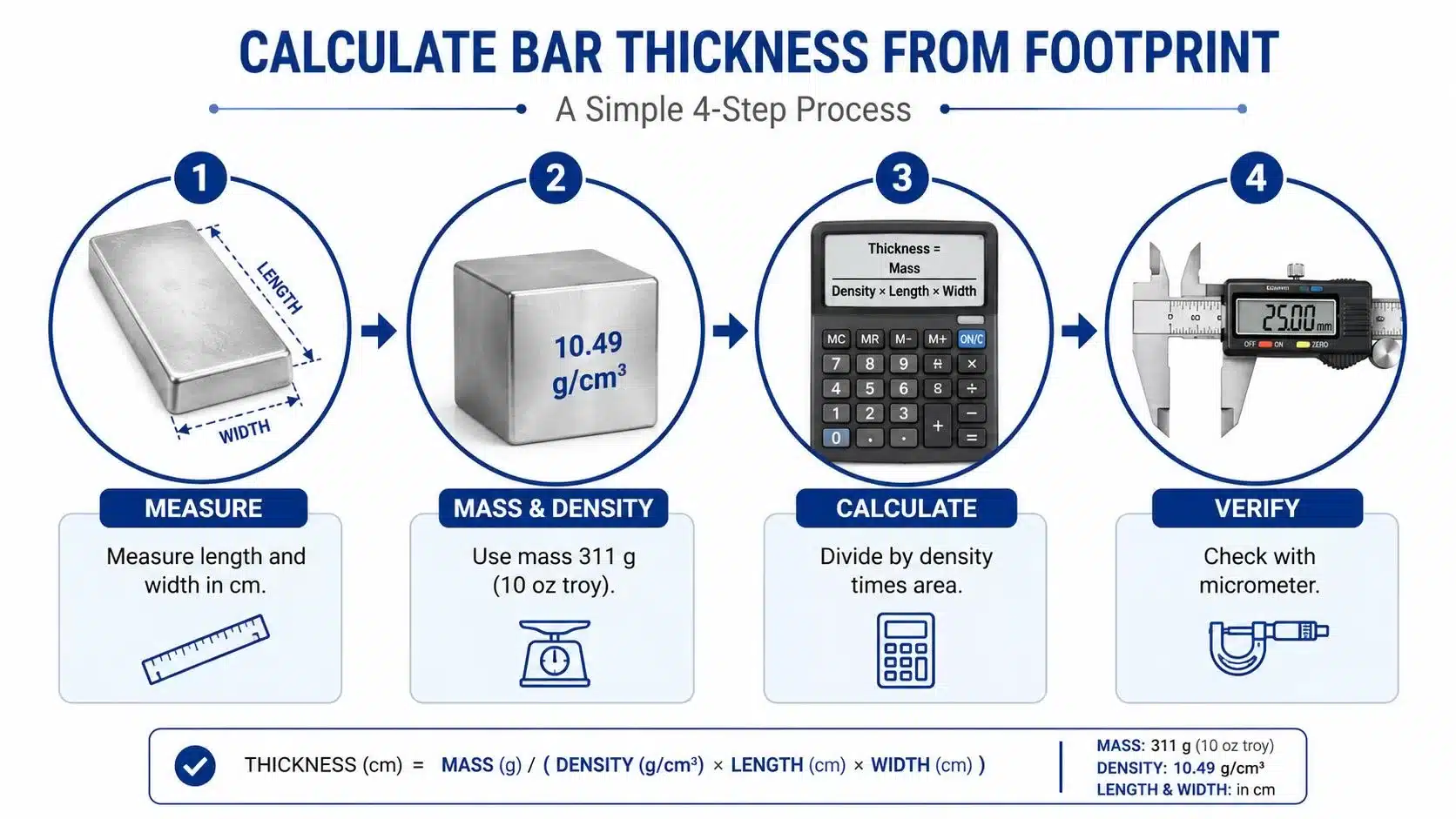
Silver's density provides a useful reasonableness check. The calculation works because mass equals density multiplied by volume, and a rectangular bar's volume comes from length multiplied by width multiplied by thickness.

Use a consistent unit system
The process is:
- Measure the bar's length and width in centimeters.
- Use a mass of about 311 g for 10 troy ounces.
- Apply the formula: Thickness = Mass / (Density × Length × Width).
- Compare the result with a physical measurement from a caliper or micrometer.
The infographic uses silver density of 10.49 g/cm³, a mass of 311 g, and the formula above. Measurements must be converted from millimeters to centimeters before calculation. For example, 90 mm becomes 9.0 cm.
This approach works best for a bar with relatively flat faces. Cast bars may have rounded edges, irregular surfaces, or slight shape changes, so the calculated figure represents an approximation rather than a laboratory assay.
A tax or retirement investor who needs organized documentation may also benefit from the Blue Sage Tax & Accounting expertise, especially when physical-asset records must align with broader financial files. The calculation doesn't replace professional authentication, but it can flag an obvious mismatch for further review.
Cast Bars Versus Minted Bars
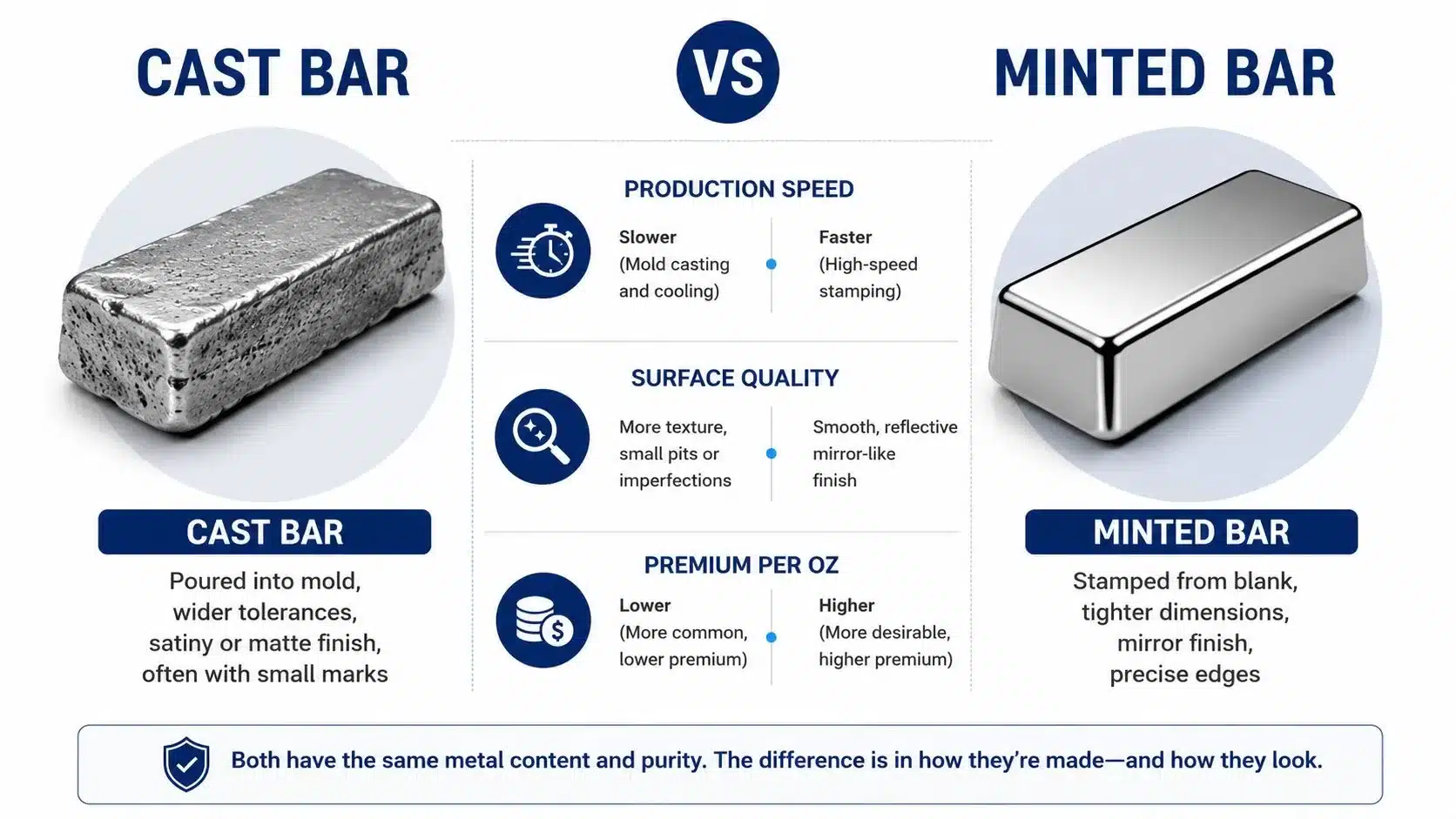
Manufacturing method often explains the biggest visual difference between two bars with the same weight. Cast bars begin as molten silver poured into a mold. Minted bars are generally formed from rolled silver sheet or blanks and then stamped, which supports flatter surfaces and more uniform edges.
The physical differences
Cast formats often appear:
- Thicker and narrower, depending on the mold.
- More rustic, with a satiny or matte surface.
- Less uniform at the edges, within the manufacturer's tolerances.
- Marked by small surface features, which don't automatically indicate a problem.
Minted formats commonly appear:
- Flatter and broader, with a consistent rectangular profile.
- Sharper at the edges, because the blank is stamped.
- More polished, sometimes with a reflective finish.
- Easier to measure consistently, which helps with tray planning.
Neither method is automatically superior. A retirement investor should give more attention to maker recognition, purity, documented weight, total cost, and resale procedures than to whether the surface looks rustic or polished.
The manufacturing distinction becomes especially useful when an investor receives a bar that looks unlike a familiar example. Appearance alone isn't enough to judge authenticity, so any concern should lead to a specification check and, when appropriate, professional testing.

Storage and Safe Fit Considerations
A storage compartment designed for a flat minted bar may not accommodate a chunky cast format. Width and thickness can matter as much as total footprint, particularly when bars are placed in fitted trays or protective holders.
Measure the interior space, not merely the advertised exterior dimensions of a safe or box. Hinges, dividers, foam inserts, sleeves, and tamper-evident packaging can reduce usable clearance. Packaging also adds to the overall height and width, so the bar's bare-metal measurements shouldn't be treated as the final storage requirement.
Build the storage plan around the SKU
A practical inventory sheet should include:
- Manufacturer and product name, so future replacements can be matched accurately.
- Length, width, and thickness, taken from the product specification.
- Packaging status, including whether the bar remains sealed.
- Quantity and stacking arrangement, so weight and access remain manageable.
- Serial or identifying marks, when the product uses them.
A mixed-brand collection may require more empty space than a collection of identical bars, even when every piece carries the same 10 oz label. Leave room for future acquisitions rather than filling every compartment immediately.
For retirement investors considering professional custody, the precious metals storage guide provides useful context about storage arrangements and the separation between personal possession and custodian-controlled holdings. A home safe, bank facility, and approved depository each involve different access, insurance, and documentation considerations.
IRA Eligibility and Documentation Requirements
A 10 oz bar may be suitable for a precious-metals IRA only when it meets the applicable purity, product, custodian, and storage requirements. Listings commonly identify silver bars as .999 to .9999 fine, but the retirement account provider and custodian must confirm eligibility for the specific product.
At intake, a custodian or depository may record the maker, weight, fineness, markings, packaging condition, and identifying number when one exists. Exact dimensions help distinguish similar products and support inventory controls, especially when multiple refiners produce bars with different geometries.
Documentation principle: The bar's exact product identity matters more than the generic phrase “10 oz silver.”
Investors should obtain the product specification before purchase and keep invoices, certificates, assay information, and transfer records with their retirement documentation. The IRA-eligible silver guide offers further educational context, but individual account rules and custodian procedures can differ.
This is not financial advice. Consult a licensed financial advisor, CPA, or tax professional before making investment decisions.
Investment Tradeoffs and Liquidity Considerations
Could a 10 oz bar offer a practical middle ground for retirement investors? Its size is compact enough for manageable storage, yet large enough to reduce the number of individual pieces. The tradeoff is that value depends on more than silver weight. Shape, brand recognition, condition, and market demand can all affect how easily a bar sells and the spread between its purchase and resale prices.
Three comparisons clarify the choice:
- Compared with 1 oz products: A 10 oz bar is less divisible. Selling part of the holding may require selling the entire bar, but fewer pieces simplify handling and storage.
- Compared with a 100 oz bar: A 10 oz bar permits partial liquidation without committing the investor to selling one much larger unit.
- New versus secondary-market bars: Newly packaged bars may carry a higher retail premium. Recognized secondary-market bars can sometimes provide a lower entry cost, although condition and documentation still matter.
Liquidity also depends on the exact bar's specifications. Since 10 oz bars do not share one universal footprint, storage planning should allow for the dimensions of the chosen product rather than an assumed standard. Keep the purchase premium, expected resale spread, and storage limits in the same comparison. A lower price is less useful if the bar is difficult to store, identify, or sell.
Verification Steps When Receiving or Storing Bars
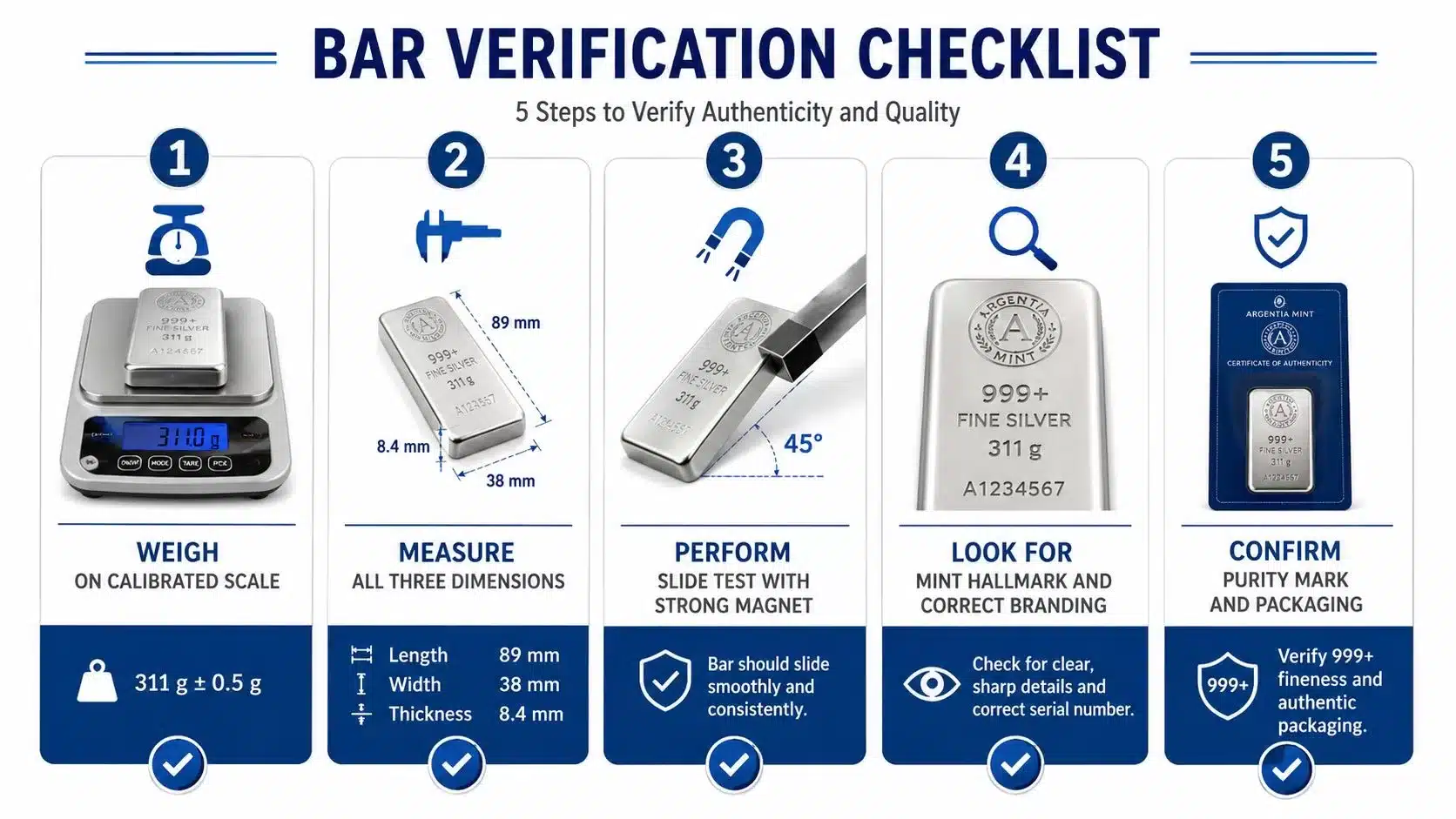
A buyer receives a bar that looks slightly thicker than an online photograph. That observation alone isn't a red flag because manufacturers use different footprints and production methods. The correct response is to compare the exact product specifications, then verify the physical bar systematically.
A practical receiving routine
- Weigh the bar on a calibrated scale and compare the result with the stated product weight.
- Measure length, width, and thickness with suitable tools. The checklist visual provides an example using 311 g ±0.5 g, 89 mm, 38 mm, and 8.4 mm, but those figures are not universal dimensions for every 10 oz bar.
- Perform a magnet slide test if the investor understands the limitations of that method. A strong magnet should be used at a 45° angle in the illustrated procedure.
- Inspect the hallmark, branding, weight, purity mark, packaging, and serial number, when applicable.
- Escalate discrepancies to a reputable dealer, custodian, or professional testing service rather than altering or reselling the bar.
Record photographs, invoices, measurements, and identifying marks. Those records can support insurance reviews, estate planning, and later conversations with a custodian or dealer.
Common Questions About 10 oz Silver Bar Sizing
Do all 10 oz bars fit standard storage solutions?
No. A flat minted bar and a compact, thick cast bar can have very different clearances. Use the exact manufacturer dimensions, then add space for packaging and protective material.
How should buyers compare bars from different manufacturers?
Compare weight, fineness, maker, dimensions, packaging, premium, and resale policy. The ounce label alone doesn't provide enough information.
What if a bar doesn't match its listed dimensions?
Recheck the measurement method and product version first. If the discrepancy remains, pause the transfer or sale and request professional authentication.
Do size variations affect resale value?
Dimensions alone don't determine resale value. Recognition, condition, purity, purchase premium, and the buyer's verification process can matter more.
Gold IRA Association provides educational guides on silver IRAs, eligible products, storage, rollovers, and provider comparisons. Visit Gold IRA Association to review the relevant resources and prepare a product-specific checklist before purchasing or transferring a 10 oz silver bar.


