




Can a Roth IRA hold physical silver without creating extra contribution room or bypassing ordinary Roth rules? No. A silver Roth IRA is still a Roth IRA, and the metal changes the investment menu, not the account's basic tax framework. The questions are whether the silver qualifies, how the account is funded, who holds the metal, and whether the fees make sense for the account balance.
What a Silver Roth IRA Actually Is
A silver Roth IRA is a self-directed Roth IRA that owns approved physical silver instead of relying only on conventional investments such as stocks, bonds, or mutual funds. The account remains a Roth IRA under the tax rules. Silver doesn't create a separate contribution category, special income treatment, or extra tax advantage.
Qualified Roth withdrawals are generally tax-free when the applicable Roth distribution requirements are satisfied. Growth inside the account also isn't taxed in the same way as taxable investments held outside a retirement account. Those benefits come from the Roth wrapper, not from silver itself.
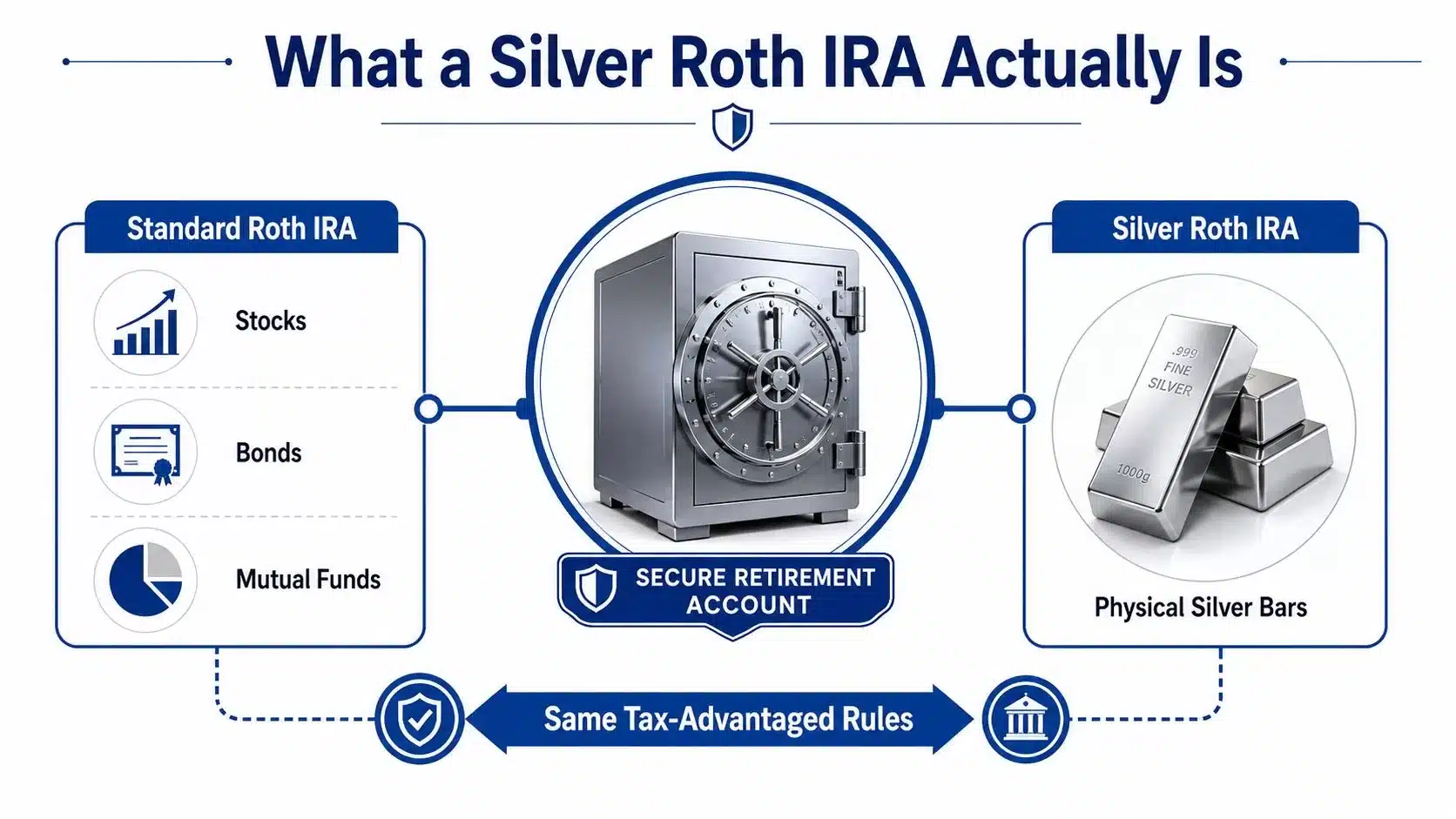

The most important distinction is practical. A standard brokerage Roth IRA may offer securities but usually doesn't provide a process for buying and storing physical bullion. A self-directed structure adds a specialized custodian and an approved depository, while the account owner directs which eligible silver the IRA purchases.
The Roth rules still apply
The account's annual contribution cap applies across all IRAs, including a silver Roth IRA funded with cash. For tax year 2026, the combined limit is $7,500 for people under age 50 and $8,600 for people age 50 and older, according to the published 2026 IRA contribution limits. The limit isn't multiplied because an investor owns multiple IRAs.
Roth eligibility also depends on income phase-outs. Choosing silver doesn't remove those limits or create a workaround for someone who can't make a direct Roth contribution. Retirement money moved through an eligible rollover follows a different process, but the destination account is still governed by Roth rules.
Why investors consider silver
Some near-retirees want physical assets alongside paper investments because silver may provide a different source of portfolio exposure. Silver can be viewed as a potential diversification tool during periods of inflation or financial-market uncertainty, but it remains an investment whose price can fall.
The central decision isn't "Can silver go up?" It's whether the investor wants physical silver badly enough to accept specialized custody, product restrictions, trading spreads, and storage expenses. Those costs can matter more than many promotional explanations acknowledge.
IRS Purity Standards and Eligible Silver Products
The eligibility test begins with fineness, which means measurable purity. Silver held by a Roth IRA generally must meet a minimum fineness of 0.999, or 99.9% pure, as described in custodial guidance on IRA-allowable precious metals.
That rule eliminates many familiar forms of silver. Sterling silver is 92.5% pure, so it doesn't meet the standard. Most pre-1965 U.S. “junk silver” coins also fail the bullion purity test, despite containing substantial silver. Collectibility, age, or a recognizable design doesn't substitute for the required fineness.
Products that commonly qualify
Approved products generally include high-fineness government bullion coins and bars produced by recognized refiners. Examples include American Silver Eagles at .999 fine and Canadian Silver Maple Leafs at .9999 fine, as summarized in the silver IRA eligibility guidance.
| Product | Purity | Type |
|---|---|---|
| American Silver Eagle | .999 fine | Government bullion coin |
| Canadian Silver Maple Leaf | .9999 fine | Government bullion coin |
| Recognized-refiner silver bars | At least.999 fine | Bullion bar |
A custodian should verify the product before the IRA places an order. Investors considering less common coins can also review educational material on the Austrian Philharmonic silver coin, but product eligibility should still be confirmed with the custodian before purchase.
Why the standard is a hard gate
The purity requirement applies at acquisition. A product that is .999 or higher can satisfy the silver fineness test, while .998 silver doesn't meet the stated benchmark. An investor shouldn't assume that a custodian can replace a non-compliant product after purchase without addressing the transaction and account records.
The modern framework traces back to the Taxpayer Relief Act of 1997. That legislation expanded IRA eligibility beyond a narrow group of coins to include qualifying bullion made from gold, silver, platinum, and palladium. The rule took effect for tax years beginning after December 31, 1997, and the resulting framework continues to govern precious-metals IRAs. Under that framework, the silver must meet the purity requirement and remain with a qualified trustee or custodian, rather than the investor personally. The historical framework is summarized in this overview of precious-metals IRA history.
How to Fund and Set Up a Silver Roth IRA
Opening a silver Roth IRA involves more than choosing a coin. The account owner must establish the correct account structure, move money through an appropriate channel, select eligible silver, and preserve the custody chain.
A practical setup sequence
Choose a self-directed custodian. Confirm that the custodian handles physical precious metals and coordinates with an appropriate depository. The custodian should explain account documents, transaction procedures, reporting, and all charges before funding begins.
Open the Roth account. Complete the application, beneficiary designations, identity checks, and transfer or rollover paperwork. The account should be titled in the IRA's name, not in the owner's personal name.
Select the funding method. A cash contribution is subject to the combined annual IRA limit. A rollover or transfer from another retirement account follows separate procedural rules, and the source and destination account types matter.
Direct the purchase. After the cash reaches the account, the owner gives the custodian investment instructions for specific eligible silver. The custodian executes the purchase, and the metal goes directly to the approved depository.
The safest funding route is usually a trustee-to-trustee transfer when available. An indirect rollover is more sensitive because the IRS says an eligible rollover distribution must reach another eligible retirement plan within 60 days of receipt, as explained in IRS Topic 413.
Practical rule: A direct transfer avoids the personal-possession problem and removes the need to manage a 60-day redeposit deadline.
The IRS also permits only one IRA-to-IRA 60-day rollover per 365-day period across all of an individual's IRAs. Trustee-to-trustee transfers aren't subject to that once-per-year restriction, according to the transfer and rollover guidance.
Before moving funds, the account owner should ask the existing plan administrator whether the money is eligible for distribution or rollover. A current employer plan may have its own restrictions. Tax treatment can also differ when pre-tax money moves into a Roth account, so a tax professional should review the transaction before execution.

For provider research, the silver IRA companies guide can help readers compare account administration, product access, storage arrangements, and fee disclosures without treating any single provider as automatically suitable.
Understanding Fees and the Economics of Silver Storage
Silver can have a lower purchase price per ounce than gold, but that doesn't make it cheaper to hold inside an IRA. Value density is the hidden issue. Silver is heavier and takes more physical space for the same dollar value, so storage can be less efficient than gold storage.
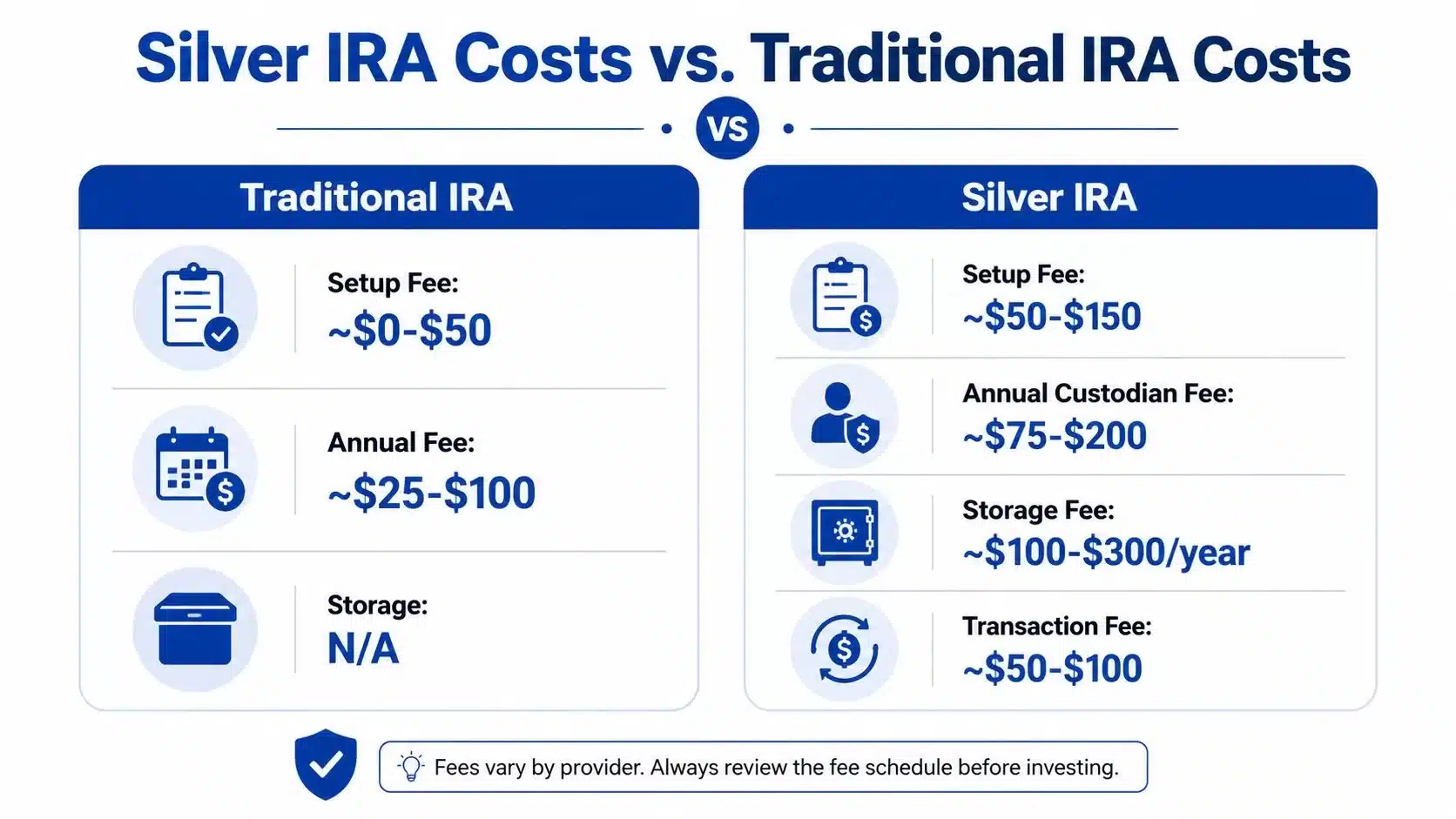
A recent fee breakdown places silver IRA storage at approximately 0.15% to 0.60% of assets annually, and explains that depositories may charge more per dollar for silver because the metal is heavier for the same value. The figures and reasoning appear in this silver IRA fee analysis.
Where the costs arise
A provider's fee schedule may include several separate charges:
- Account setup: An initial administrative charge for establishing the self-directed account.
- Custody: An ongoing fee for recordkeeping, reporting, and account administration.
- Storage: A charge for holding and safeguarding the IRA-owned silver at a depository.
- Transactions: Costs associated with purchasing, selling, shipping, or processing bullion orders.
- Dealer spread: The difference between the price paid for silver and the price available when selling.
The storage range alone doesn't tell the whole story. A small account can face a larger proportional burden because fixed administrative charges and physical-storage costs are spread across fewer assets. That doesn't mean silver is unsuitable, but it does mean the account balance, holding period, purchase size, and expected liquidity all deserve attention.
Silver versus gold
Gold generally carries more value in a smaller physical package, while silver requires more space and handling for an equivalent value. As a result, silver's custody economics can be less favorable, particularly for investors with modest balances.
The decision should therefore include a break-even conversation. An investor can ask how much of the account may be consumed by recurring custody and storage costs, then compare that drag with the intended diversification role. The metal's potential appeal doesn't erase the cost of owning it.
Fee question to ask: Request the complete schedule in writing, including charges that apply when buying, selling, transferring, shipping, or closing the account.
The infographic above includes fee figures for illustration, but those amounts aren't a substitute for a provider's current written schedule. Fees vary by arrangement, and investors should verify every charge before authorizing a purchase.
Storage Requirements and Compliance Risks
Who controls the silver matters as much as which silver the IRA buys. A silver Roth IRA is not a home-storage arrangement. The IRA ordinarily purchases the metal, the custodian records ownership, and an independent approved depository holds the silver. IRS-appropriate precious-metals storage guidance explains why external custody supports the account's intended tax treatment. For a practical overview, see our guide to precious metals storage requirements.
Taking possession can create serious compliance risk. If the owner brings the silver home or puts it in a personally controlled safe deposit box, the IRS may view that action as a distribution under constructive-receipt or prohibited-transaction principles. Tax consequences and penalties may follow, depending on the account and the investor's circumstances. The physical metal should remain under the custody arrangement, even when the owner selected the investment.
The custody chain
The ownership path should be easy to document:
- The IRA owns the metal. The title and account records should identify the retirement account, not the individual.
- The custodian executes the transaction. The owner gives investment direction, while the custodian processes the account transaction.
- The depository holds the bullion. An independent third party approved for this type of retirement asset should hold the silver.
- Records connect each step. Purchase invoices, shipping records, vault receipts, and account statements should agree.
Segregated and commingled storage
Segregated storage keeps specific coins or bars separate and identifies them for the account. Commingled storage places qualifying metal with similar assets belonging to other customers, while the account retains a documented ownership interest in the applicable quantity.
The label alone does not answer the practical questions. Ask how the depository identifies holdings, how insurance applies, how audits are conducted, and what occurs during a sale or transfer. Both arrangements can work when records are clear and the investor cannot personally control the IRA-owned silver.
The storage agreement should also describe delivery procedures. At retirement, an investor may request an in-kind distribution, but receiving physical metal remains a distribution event governed by Roth rules. The account owner should not remove silver informally or treat the depository as a personal vault.
Compliance Checklist Before You Open an Account
A short verification process can prevent expensive mistakes. The following checklist is designed for conversations with a custodian, depository, or tax professional.
- Verify the custodian: Confirm that the firm administers self-directed precious-metals IRAs and clearly identifies its role.
- Confirm the depository: Obtain the storage facility's name, custody terms, insurance information, and delivery process.
- Check the silver: Verify that each proposed product meets the .999 minimum fineness before the order is placed.
- Review every fee: Request setup, custody, storage, transaction, shipping, and liquidation charges in writing.
- Choose the funding route: Decide whether the money will arrive through a contribution, direct transfer, or rollover.
- Calendar the deadline: If an indirect rollover is used, document the date funds are received and the date they must be redeposited.
- Review the account title: Make sure the IRA, not the investor personally, owns the silver.
- Ask for tax review: Have a CPA or tax professional examine any conversion, rollover, distribution, or unusual transaction.
Regulatory compliance advice can also be useful as a general checklist discipline beyond retirement accounts. Readers seeking broader guidance may consult Victorville regulatory compliance advice from David J. Greiner Law Corp, while recognizing that retirement-account questions require professionals familiar with IRA and tax rules.
Gold IRA Association provides educational guides, comparison material, and checklists that can help readers organize these questions before speaking with a provider. The resource doesn't replace account-specific tax, legal, or investment advice.
Frequently Asked Questions About Silver Roth IRAs
Can the owner take physical possession at retirement?
An owner may request an in-kind distribution if the account and custodian permit it, but the distribution must follow applicable Roth rules. Physical delivery isn't an informal withdrawal, and the owner should obtain tax guidance before requesting it.
Does a silver Roth IRA have required minimum distributions?
Roth IRA owners generally don't face required minimum distributions during their lifetime under the same framework that applies to traditional IRAs. Beneficiaries can face distribution requirements after inheritance, so an estate-planning and tax review remains important.
Can inherited silver be received tax-free?
The Roth account's tax treatment doesn't automatically make every inherited distribution tax-free. Beneficiary status, holding periods, distribution timing, and the form of the distribution can affect the result.
What happens after a non-compliant purchase?
The owner should contact the custodian immediately and avoid taking possession or attempting an informal correction. A product below the purity standard may fail the metals test, so the custodian and a qualified tax professional should determine the proper corrective action.
This is not financial advice. Consult a licensed financial advisor, CPA, or tax professional before making investment decisions.
Gold IRA Association offers educational guides on silver Roth IRA rules, eligible metals, rollovers, storage, fees, and provider research. Visit Gold IRA Association to review the available resources and prepare a focused list of questions before opening or funding an account.


