




Fort Knox holds roughly 147.3 million fine troy ounces of gold. At the Treasury's fixed statutory rate, that comes out to about $6.2 billion, but at modern market prices the same gold can land anywhere from roughly $442 billion to $589 billion, depending on the spot price used.
That gap is why Fort Knox headlines confuse people. The number hasn't changed much, the valuation method has, and that difference matters more than most casual coverage admits.
What Readers Get Wrong About Fort Knox Gold
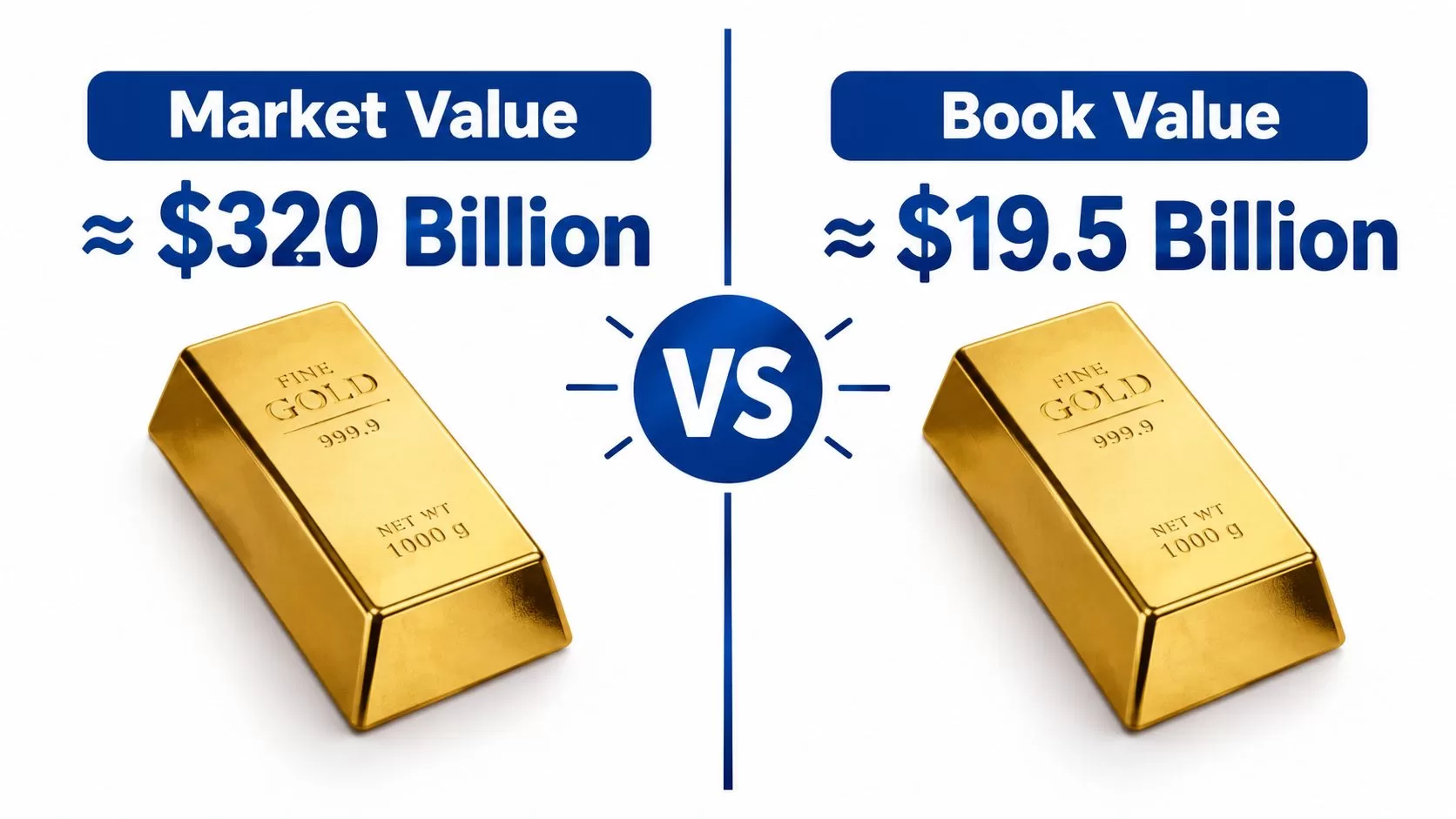

The first mistake is treating book value and market value as if they answer the same question. They do not. Book value uses a fixed government accounting rate. Market value uses what gold could fetch today, which is why the same metal can show up as a modest line item in one calculation and a far larger figure in another. The difference is the same one explained in the price versus value discussion, and it drives almost every Fort Knox headline.
A second mistake is reading a bigger headline number as proof that more gold appeared. The reported quantity is the starting point, but the valuation method is what changes the result. That is why the Fort Knox conversation so often sounds inconsistent even when the underlying gold has not changed.
Fort Knox holds roughly 147.3 million fine troy ounces of gold according to Treasury reporting. At a modern spot price, that stock can be worth roughly $442 billion to $589 billion, depending on the price used.
For a reader trying to make sense of the value of gold in Fort Knox, the clean rule is simple. Ask which value is being used before trusting the number. If the article does not say, the figure is incomplete.
What Fort Knox Actually Stores and Where It Fits
Fort Knox is one vault in the U.S. government's wider gold system, and the scale is easy to miss if you only hear the headline. The U.S. Bullion Depository at Fort Knox, Kentucky holds about 147.3 million fine troy ounces of gold, roughly 4,583 metric tonnes according to the U.S. Treasury's published reserve data. The rest of the federal gold stock is kept at other depositories, so Fort Knox is a major share of the total, not the whole reserve. The U.S. Mint states the Depository has operated since 1937, which helps explain why it has become the default reference point in gold stories.
The point of a place like this is custody, not access. Fort Knox is built for controlled storage, with layered safeguards and tightly managed entry so no single person can walk in and control the metal. That is why readers who want a real-world comparison often look at secure military storage from Material Handling USA, since the basic logic is similar, layered access, controlled movement, and physical protection around high-value assets.
U.S. Treasury Gold Storage Sites
| Facility | Location | Role |
|---|---|---|
| Fort Knox Bullion Depository | Fort Knox, Kentucky | Deep storage for a large share of U.S. government gold |
| West Point Mint | West Point, New York | Holds part of the national gold reserve |
| Denver Mint | Denver, Colorado | Holds part of the national gold reserve |
| Federal Reserve Bank of New York | New York, New York | Holds part of the national gold reserve |
That structure matters for valuation. Fort Knox is a depository, not a retail vault and not an investable product. Its bars sit inside the federal reserve system, where the relevant questions are custody and accounting, not whether an individual buyer can purchase the gold outright.
How the Official Book Value Is Calculated
147.3 million fine troy ounces is the starting point for Fort Knox's official book value, based on Treasury gold reserve reporting. The calculation then applies a statutory accounting rate rather than the latest trading price.
Federal accounting assigns gold a rate of $42.2222 per fine troy ounce under the federal law governing U.S. gold valuation. Because that rate is fixed for this accounting purpose, Treasury does not reprice the reserve each time the bullion market rises or falls.
The arithmetic is simple:
- Start with the reported Fort Knox holdings.
- Multiply those ounces by $42.2222.
- Record the result as book value.
- Treat it as a federal accounting figure, not the amount the gold would necessarily bring in a sale.
The calculation is 147.3 million oz × $42.2222 ≈ $6.22 billion, using the reported holdings and statutory rate cited in Treasury gold reserve reporting. This explains why the roughly $6.22 billion figure appears in official accounting, even though a market-price calculation produces a far larger estimate.
Book value works like a label in a ledger. It records the reserve under a prescribed rule, while market value asks what buyers might pay under current conditions. The two figures answer different questions, so neither automatically replaces the other.
The distinction resembles ordinary business analysis. expert business valuation insights often separate recorded cost, replacement value, and sale value. Fort Knox accounting follows the same basic principle: the meaning of a number depends on the valuation method behind it.

The unit also matters. A fine troy ounce is the measure used for gold, not a regular household ounce. The guide to troy ounce versus regular ounce helps prevent a unit error before the calculation begins.
How to Estimate Market Value From Ounces and Spot Price
Market value starts with the reported gold quantity and replaces the statutory rate with a market price. The formula is simple: fine troy ounces × current spot price = estimated market value. It works like pricing a large inventory item. The quantity stays fixed for the calculation, while the price assigned to each ounce changes.
A fine troy ounce is the correct unit for gold. It is different from a regular household ounce, so using the wrong measure would distort the result before the price is even applied. The guide to how much one bar of gold is worth connects that unit question to a more familiar way of understanding gold's value.
Fort Knox Market Value at Common Spot Prices (147.3M oz)
| Spot Price per oz | Calculation | Estimated Market Value | Context |
|---|---|---|---|
| $2,400 | 147.3 million × $2,400 | about $353.5 billion | Lower-end recent pricing framework |
| $3,000 | 147.3 million × $3,000 | about $441.9 billion | Mid-range simple estimate |
| $3,500 | 147.3 million × $3,500 | about $515.6 billion | Higher-end simple estimate |
The table uses October 2026 spot-price scenarios. To reproduce any estimate, record the exact spot price and date beside the calculation, then multiply that price by the ounce figure being used. These are arithmetic illustrations, not a claim that gold stayed at one price throughout the month.
The result can change by hundreds of billions even though the reported quantity barely changes. That sensitivity explains how the official figure near $6 billion and a market estimate above $400 billion can both be correct. They use different valuation rules.
A rough market estimate shows the metal's theoretical value at a selected price. It does not account for sale frictions, storage costs, or the difference between the quoted price and what a real transaction would net.
For a near-retiree, the practical distinction is clear. Market value estimates what the gold might be worth at a stated point in time. Book value records the government's assigned accounting value. Treat the market figure as a calculation built from two inputs, ounces and price, rather than as cash the reserve would automatically bring in through a sale.
Why Headline Numbers Keep Changing
A Fort Knox headline is a snapshot, not a permanent label. Two reports can produce different totals while using the same underlying reserve because they may round the ounces, choose different gold prices, or use different dates.
Rounding creates the first gap. One article may use 147 million ounces, while another uses 147.3 million. A rounded figure is easier to read, but the difference becomes more visible after multiplication by a high gold price. The extra decimal places do not necessarily signal better research. They may only show a more precise input.
The price used creates a larger swing. Gold changes throughout the trading day, so a calculation based on one quoted level will not match one completed later. Timing matters, too. One writer may capture an intraday high, while another uses a closing price or a broader average. Each result describes its chosen moment.
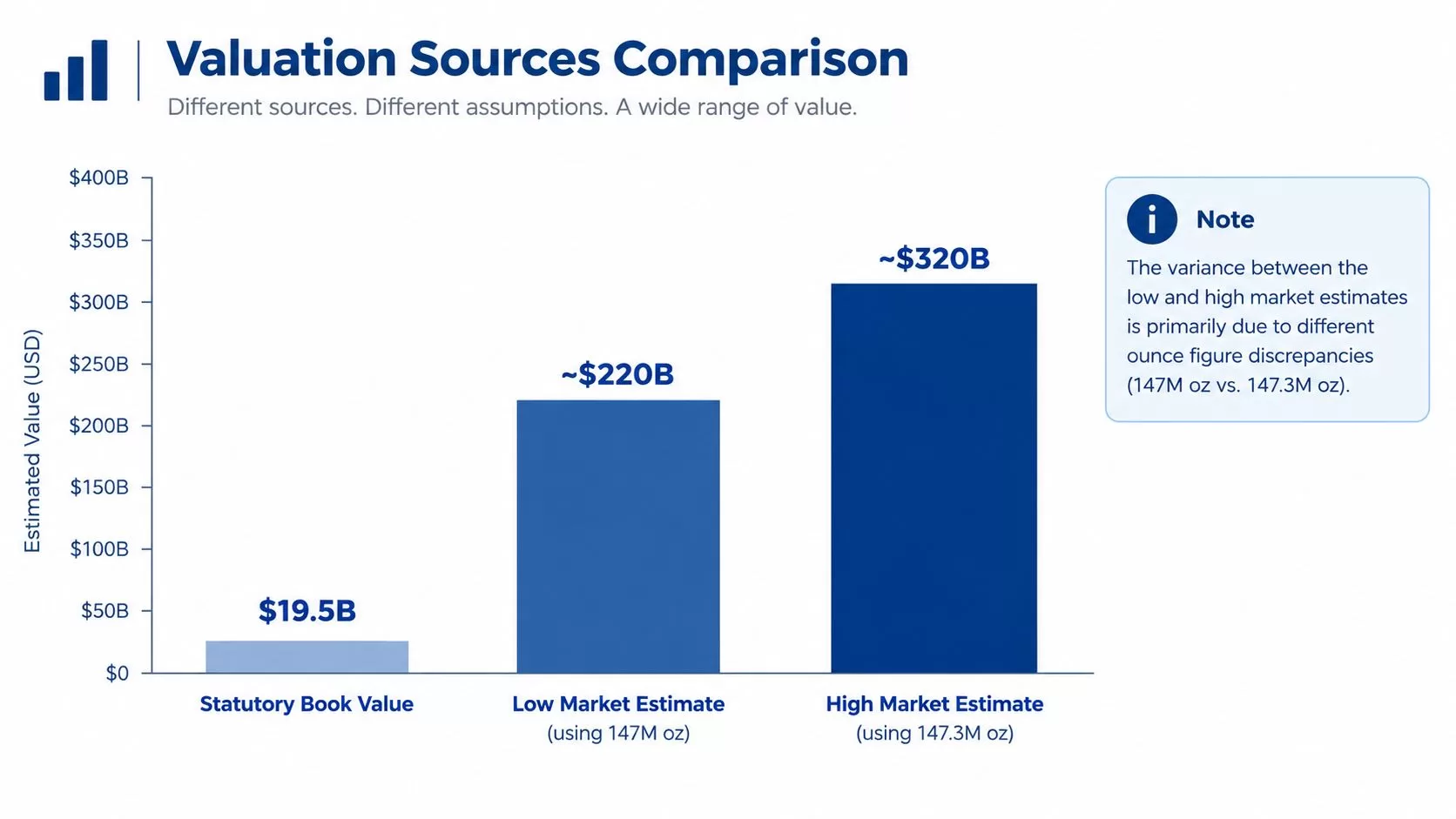
Read any headline by checking three details:
- Which ounce figure was used? Look for a rounded count or a more precise one.
- Which gold price was used? This input drives the market estimate.
- Which date was used? Without a date, the number lacks context.
That explains why one calculation can support the official figure near $6 billion, while another produces a market estimate above $400 billion. The figures use different inputs and valuation rules. The value of gold in Fort Knox therefore needs its calculation shown, not just its headline.
What “Audited” Means and What It Doesn't Prove
The word audited often suggests a complete, current inspection, but Fort Knox records support a narrower conclusion. The Government Accountability Office observed a physical inventory in 1974 covering three of the depository's 13 compartments, checked records, and observed assays of sampled bars, as described in the GAO's published materials. That inspection provides documented evidence, but it does not establish continuous, public, bar-by-bar verification of every compartment.
An inspection can confirm that sampled gold was present, that records agreed with the compartments examined, and that selected assay results met the applicable ranges. It cannot provide a live public count of every bar stored in every restricted area. The distinction resembles checking several boxes in a warehouse rather than opening and recounting every box.
Keep these terms separate:
- Physical inventory means inspectors counted the holdings they could access.
- Sampling means only part of the reserve was examined.
- Assay testing means the metal content of selected bars was tested.
- Financial auditing means accounting records were reviewed under established rules.
An inspection can support confidence without answering every possible question.
That distinction matters when assessing the value of gold in Fort Knox. An audit or inspection can reduce uncertainty about custody, records, and sampled metal. It does not determine a sale price, prove that every bar was examined, or turn the government's accounting figure into a current market valuation. Those questions require separate evidence and a separate calculation.
What Fort Knox Valuation Means for Your Own Gold Decisions
The Fort Knox story becomes useful when it stops being a headline and starts being a model. The government's book value is an accounting convention, but a private investor cares about spot value, dealer pricing, storage costs, and the gap between what something is quoted at and what it can realistically be sold for.
That's where scale matters. A small move in gold can translate into a very large change at Fort Knox because the holding is huge. The same move on a personal position is much smaller in dollar terms, which keeps the comparison grounded for a retirement saver. The lesson isn't that everyone should chase gold. The lesson is that metal prices move, and the effect depends on how much is owned.
Individual investors also face costs the federal reserve system doesn't think about in the same way. Dealer markups, insurance, storage, and taxes all affect the net result. Those frictions are one reason gold is usually better understood as a diversification and insurance layer than as a pure growth asset.
For a near-retiree, the decision should come back to three practical questions:
- Time horizon: How long can the money stay invested?
- Portfolio mix: What else is already owned?
- Risk tolerance: How much volatility feels manageable?
That framework matters more than any single Fort Knox estimate. A headline number can explain the scale of the metal, but it can't decide the right allocation for a retirement portfolio.
Gold IRA Association publishes plain-English guides that help readers understand gold, silver, rollovers, and retirement-account basics without the noise. If you want a clearer path from headline numbers to practical retirement planning, visit Gold IRA Association for educational resources you can review at your own pace. This is not financial advice. Consult a licensed financial advisor, CPA, or tax professional before making investment decisions.


