




The popular advice says a rollover IRA and a traditional IRA are two competing retirement products. That framing is misleading. In most cases, a rollover IRA is a traditional IRA holding money that came from an employer plan, while a traditional IRA may also hold direct personal contributions. The important questions are how the money arrived, whether the transfer followed IRS timing rules, how the assets are recorded, and what the owner may want to do next.
Why the Rollover IRA vs Traditional IRA Question Is Mostly Misleading
The phrase rollover IRA vs traditional IRA suggests a choice between two different IRS account types. That is usually the wrong starting point. A rollover IRA generally describes a traditional IRA whose assets came from an employer-sponsored plan, such as a 401(k) or 403(b). The label records the money's route into the account. It does not create a separate federal tax category.
Financial institutions use the labels for practical reasons. One account statement might say “Rollover IRA,” while another application might say “Traditional IRA.” Those names help track funding history and organize paperwork, but the underlying account may still operate under traditional IRA rules.
The history can matter, even when the tax framework is broadly the same. Keeping employer-plan assets identifiable may simplify recordkeeping, help document the source of the funds, and make a later transfer into another employer plan easier to evaluate. It can also clarify the paperwork if the owner considers a Roth conversion or a self-directed Gold IRA. In a self-directed Gold IRA, the administrative details become more visible. The owner must review the custodian, determine whether assets can move in kind, and understand the account's fees before treating the label as a solution.
The practical question isn't which label wins. It's whether the money arrived correctly and whether the account supports the owner's next decision.
For someone nearing retirement, four questions provide a more useful comparison:
- Source of funds: Did the assets come from an employer plan, or from direct IRA contributions?
- Transfer method: Did the financial institutions transfer the assets directly, or did the participant receive the distribution?
- Recordkeeping: Are rollover assets distinguishable from personal contributions and any after-tax basis?
- Future use: Might the assets later move into an employer plan, a Roth IRA, or a self-directed Gold IRA?
This approach keeps attention on the risks. Missing a deadline, accepting avoidable withholding, mixing money with different histories, or overlooking plan features can matter far more than the account title. The name is a filing aid. The transaction history and the next use determine the practical consequences.
What Each Account Actually Is Under IRS Rules
The phrase rollover IRA sounds like a separate IRS account type. It is not. A traditional IRA is the underlying account category. A rollover IRA is generally a traditional IRA whose balance came from an eligible employer-sponsored retirement plan rather than from direct personal contributions.
A traditional IRA can receive personal contributions and eligible rollovers. Whether a contribution is deductible depends on factors such as the investor's income, tax filing circumstances, and access to an employer-sponsored retirement plan. That deduction question is separate from the label attached to the account.
A rollover IRA usually begins when pre-tax assets leave an employer plan and enter an IRA. The receiving institution may retain the rollover designation to identify the money's origin. That record can matter later, especially if the owner considers moving the assets into another employer plan or combining them with money that has a different tax history. The designation helps with administration, but it does not create a separate set of traditional IRA tax rules.
Both accounts generally offer tax-deferred treatment. Investment growth is generally not taxed while it remains inside the IRA, while withdrawals of pre-tax amounts are generally included in taxable income. An early distribution may also create penalty exposure if no exception applies. The result depends on the owner's facts, the type of distribution, and whether the transaction is a rollover or a Roth conversion.
The shared rules matter more than the name
After eligible assets enter either account, the broad framework is generally the same:
- Withdrawals: Distributions from pre-tax traditional IRA assets are generally taxable.
- Required minimum distributions: Calling the account a rollover IRA does not remove traditional IRA RMD obligations.
- Penalty rules: An applicable exception may be needed to avoid an early-withdrawal penalty.
- Conversions: Either account may be considered for a Roth conversion, although converted pre-tax amounts are generally taxable.
- Investment administration: The custodian's available investments, service arrangements, and fees affect the account's practical use.
The label still has a recordkeeping purpose. It can preserve source-of-funds provenance, helping the owner distinguish rollover assets from direct contributions and track any nondeductible contribution basis. That distinction may also matter if a future employer plan has rules about accepting IRA money.
For a self-directed Gold IRA, the same principle applies. The account remains an IRA, while the custodian, permitted investment structure, in-kind transfer process, and fees determine how the arrangement works in practice. The label identifies the money's history. It does not, by itself, make the account more flexible or change its tax treatment.
Tax Treatment, RMDs, and Protections Compared Side by Side
The table below separates the rules that are generally shared from the areas where the account's history or destination can affect planning.
| Criterion | Traditional IRA, direct contributions | Rollover IRA |
|---|---|---|
| Tax on contributions | Contributions may be deductible depending on the investor's circumstances. Nondeductible contributions create basis that must be tracked. | Rollover contributions from eligible pre-tax employer-plan assets are generally not taxable when completed correctly. |
| Tax on growth | Growth is generally tax-deferred inside the account. | Growth is generally tax-deferred inside the account. |
| Tax on withdrawals | Pre-tax amounts are generally taxable when withdrawn. | The same traditional IRA withdrawal rules generally apply. |
| RMD treatment | Subject to the traditional IRA RMD rules. | Subject to the same traditional IRA RMD rules. |
| Early-withdrawal exposure | A taxable distribution before the applicable age threshold may also face an early-withdrawal penalty unless an exception applies. | The same general withdrawal and penalty framework applies. |
| Creditor protection | Protection can differ from employer plans and depends on applicable federal and state law. | Protection can differ from employer plans and depends on applicable federal and state law. |
| Conversion eligibility | Can generally be converted to a Roth IRA, with tax consequences for pre-tax amounts. | Can generally be converted to a Roth IRA under the same traditional IRA conversion rules. |
| Future employer-plan portability | A plan may limit acceptance of an IRA containing personal contributions or mixed sources. | A pure rollover IRA may offer cleaner documentation for a possible move into an employer plan. |
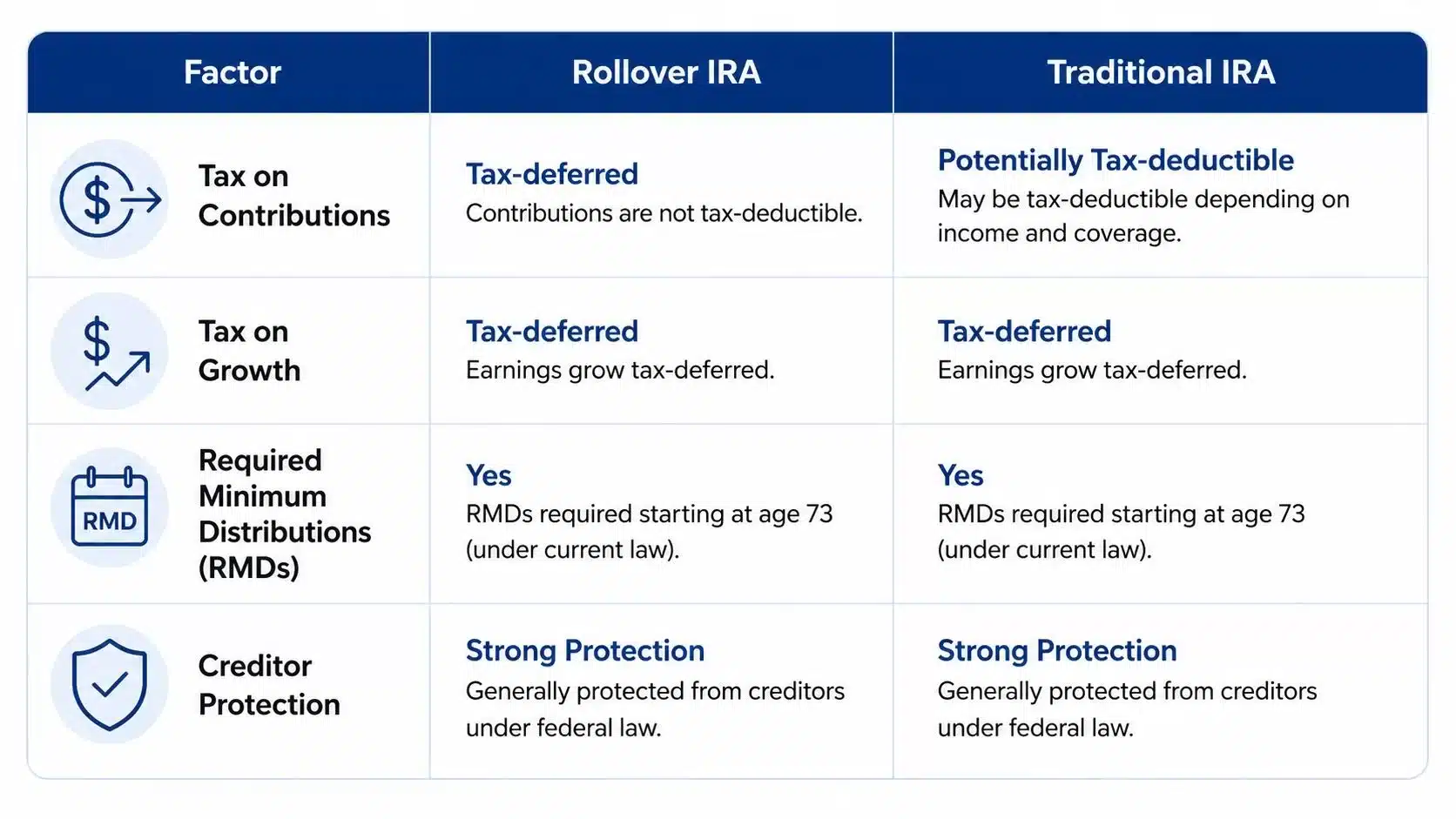

The largest practical differences usually appear outside the basic tax treatment. Employer plans can offer plan-specific features and creditor protections that may not carry over identically after an IRA rollover. Applicable protection depends on the type of claim, the governing law, and the investor's circumstances, so an owner shouldn't assume an IRA and an employer plan receive identical treatment.
Future portability also deserves attention. A pure rollover IRA can provide a cleaner record of employer-plan money, while a mixed-source IRA may create acceptance problems if a future employer plan only accepts certain rollover assets. Investors comparing options can also review this guide to IRA rollover taxes before moving retirement funds.
How Money Actually Moves Between Accounts
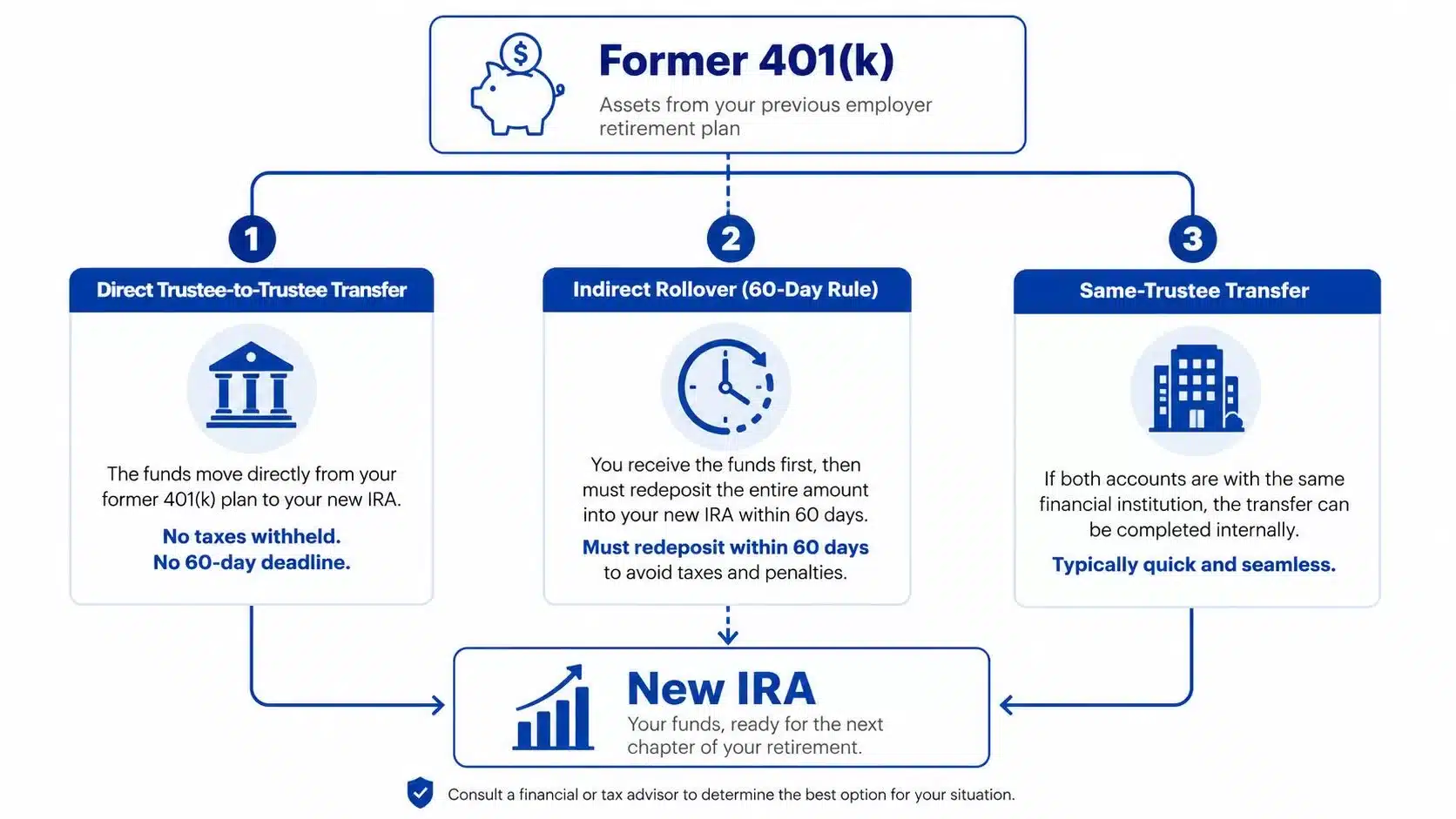
The transfer method often matters more than the account label. A properly executed direct transfer can reduce the number of steps the participant must personally manage, while an indirect rollover places deadlines and documentation responsibilities on the account owner.
Direct trustee-to-trustee transfer
With a direct transfer, the sending institution moves the money to the receiving IRA custodian without paying the distribution to the participant. The IRS treats trustee-to-trustee transfers differently from rollovers. They generally aren't subject to the 60-day redeposit clock or the one-rollover-per-year restriction, and they typically avoid the participant receiving the funds directly.
A common workflow looks like this:
- Open or identify the receiving IRA. The account should be eligible to receive the assets.
- Complete the transfer authorization. The receiving custodian usually provides the form or coordinates the request.
- Provide sending-account details. The plan administrator or current custodian verifies the account.
- Confirm delivery instructions. The transfer may move electronically or by a check payable to the receiving trustee.
- Keep the paperwork. The participant should retain confirmations showing the source, destination, and transaction date.
The IRS explains that an IRA distribution used for an indirect rollover generally must reach another eligible IRA within 60 days, while trustee-to-trustee transfers aren't treated as rollovers under the once-per-year restriction in its rollover distribution guidance.
Indirect rollover
An indirect rollover occurs when the participant receives the distribution and then deposits it into another IRA. The 60-day rule becomes central. Missing the deadline can cause the distribution to become taxable and may also create a 10% early-withdrawal penalty for someone under age 59½, as described in the IRS guidance on waivers of the 60-day rollover requirement.
Eligible employer-plan distributions paid to the participant can also involve mandatory federal withholding. The participant may need to replace the withheld amount from other funds to roll over the full distribution, which makes this route more complicated than a direct transfer.
The IRS limits IRA-to-IRA 60-day rollovers to one per 365-day period across all IRAs owned by the individual. Direct trustee-to-trustee transfers don't carry that same limitation. For a practical discussion of moving workplace savings, see this guide to an IRA rollover from a 401(k).
Mixing direct contributions with rollover dollars can also complicate a later move into an employer plan or a Roth conversion. The issue isn't that the account suddenly becomes invalid. The issue is that the owner and receiving plan may need more detailed records to identify which dollars qualify for the proposed transaction.
Roth Conversions and the Pro-Rata Trap
A rollover IRA and a traditional IRA can both be converted to a Roth IRA. The conversion question depends on the tax character of the assets, not the account label. Pre-tax amounts included in a conversion are generally taxable, while properly documented after-tax basis can receive different treatment.
The difficulty arises when an investor wants to convert only the after-tax portion of a mixed IRA. The IRS generally looks across the owner's traditional, SEP, and SIMPLE IRAs rather than allowing the owner to select only the most favorable dollars. This is commonly called the pro-rata rule.
Consider a simplified example. An investor has $40,000 of pre-tax rollover money and $10,000 of nondeductible basis in the same traditional IRA. The total is $50,000, so the basis represents 20% of the account and the pre-tax portion represents 80%. If the investor converts the entire account, the 80% pre-tax portion is generally the part exposed to ordinary income tax, while the documented basis is treated differently.
That investor generally can't point to the $10,000 and declare that only those dollars moved tax-free. The account's overall composition controls the calculation. Other traditional, SEP, and SIMPLE IRA balances can also affect the result.
Why separation can help
Keeping rollover assets separate from direct after-tax contributions may make records easier to maintain. It doesn't eliminate the pro-rata rule if other reportable IRA balances exist, but it can reduce confusion about the source and basis of the funds.
The issue deserves extra attention for anyone considering a future backdoor Roth strategy or a self-directed account. The IRS's Publication 590-A guidance on IRA contributions and related rules also addresses the treatment of pre-tax and after-tax amounts, which is why a tax professional should review the full IRA picture before a conversion.
Funding a Self-Directed Gold IRA From a Rollover or Traditional IRA
Consider a 60-year-old who has savings in a former 401(k) and wants to place part of the retirement portfolio in IRS-approved physical gold. The person may use either a rollover IRA or a traditional IRA as the source. The label itself doesn't determine whether the receiving self-directed IRA can accept the funds.
The cleaner path is generally a direct trustee-to-trustee transfer. The current custodian sends the assets to a self-directed IRA custodian that handles retirement-account administration and coordinates storage through an approved depository. The participant doesn't take personal possession of the retirement funds or the metals.
What the custodian handles
A typical process includes:
- Account application: The investor establishes the self-directed IRA with the chosen custodian.
- Transfer authorization: The custodian requests funds from the existing IRA or eligible plan.
- Beneficiary designation: The owner identifies the intended beneficiaries and keeps the form current.
- Product selection: The owner selects metals that meet the applicable IRA requirements.
- Storage arrangements: The custodian coordinates storage at an approved depository rather than sending the metals to the investor's home.
An in-kind transfer means eligible metals move into the receiving retirement account instead of being sold for cash first. Whether an in-kind transaction is available depends on the source account, the type of asset, the receiving custodian, and the applicable rules. In many cases, the existing account transfers cash and the self-directed custodian purchases the approved metals on the IRA's behalf.
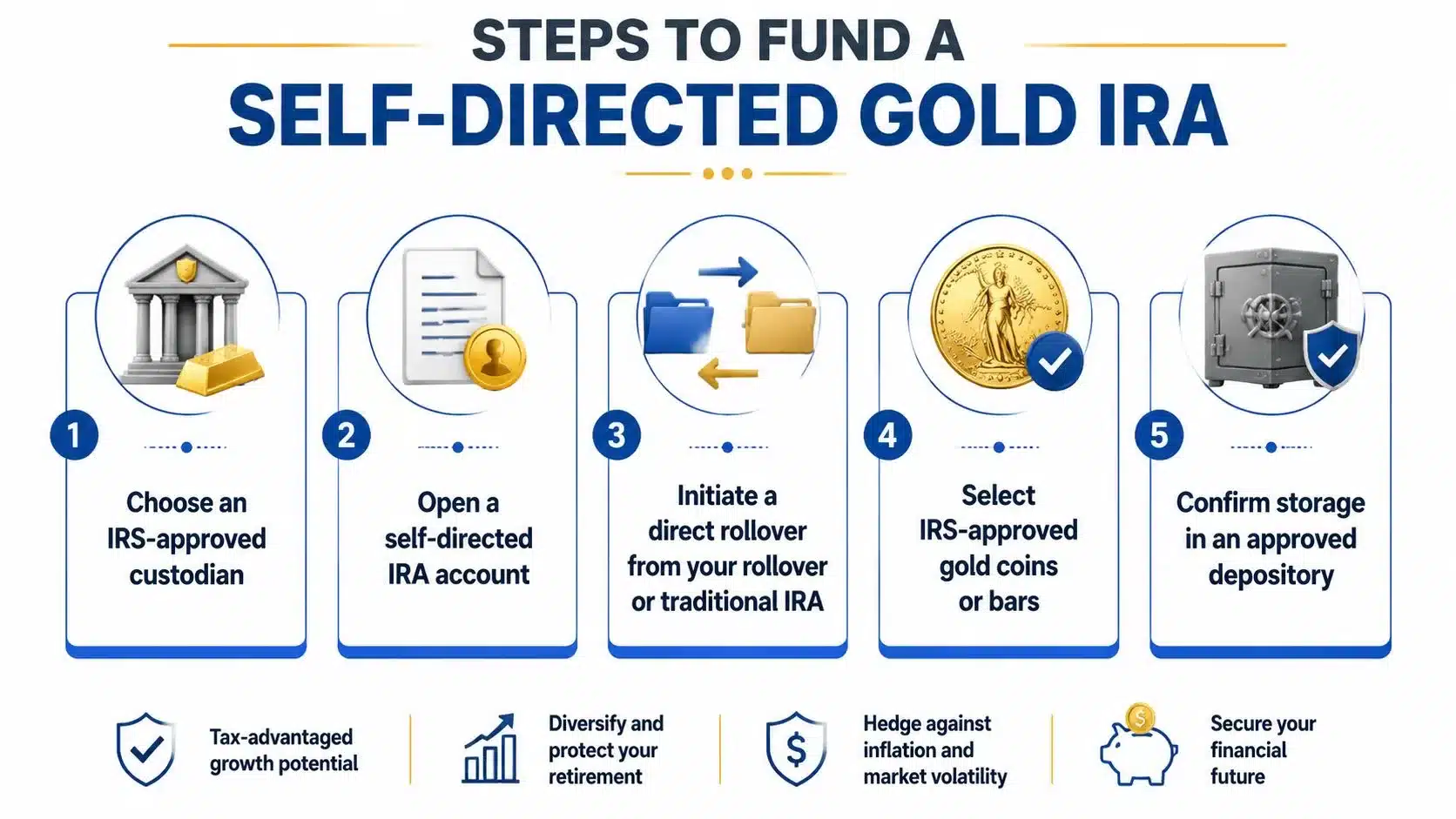
Fees should be reviewed before authorization. A provider may charge a one-time setup fee, an annual custodial or administrative fee, storage charges that differ between segregated and non-segregated storage, and per-transaction charges. The investor should request a written schedule and ask which costs apply to purchases, sales, transfers, storage, and account closure.
The Gold IRA Association publishes educational material on self-directed Gold IRA structure and funding for readers comparing custodians, documentation, storage, and fees.
The following video provides another visual overview of the funding process:

A self-directed Gold IRA can introduce additional administration and costs compared with a conventional brokerage IRA. Physical metals also carry investment risks, pricing spreads, storage considerations, and liquidity issues. This is not financial advice. Consult a licensed financial advisor, CPA, or tax professional before making investment decisions.
Common Misconceptions Worth Clearing Up
Misconception one, a rollover IRA is a special IRS account type. It's generally a traditional IRA with assets that came from an employer plan. The rollover label preserves useful administrative information, but it doesn't create separate withdrawal or RMD rules.
Misconception two, an indirect rollover is always wrong. It can be used in situations where the participant receives the funds and redeposits them into an eligible IRA. The tradeoff is substantial responsibility, including the 60-day deadline, possible withholding, reporting, and the one-rollover-per-365-day limitation for IRA-to-IRA rollovers.
Misconception three, a rollover removes RMDs. It doesn't. Moving employer-plan assets into a rollover IRA doesn't erase the owner's traditional IRA distribution obligations. The account's destination changes, but the underlying traditional IRA rules continue to apply.
Misconception four, a rollover IRA can never return to an employer plan. A pure rollover IRA may be accepted by a new employer plan if that plan permits incoming rollovers. A mixed-source IRA may be refused because it contains direct contributions or other assets the plan doesn't accept. The receiving plan's written rules determine the outcome.
Correct reporting still matters even when a rollover is tax-free. The IRS explains that a properly completed rollover is generally tax-free unless the transaction involves a Roth conversion, but the transaction still needs to be reported on the federal return in accordance with IRS Topic 413 on rollovers.
Which Path Fits Your Situation
The rollover label matters most when the owner wants clean separation, expects a future employer-plan transfer, anticipates a backdoor Roth strategy, or is considering a self-directed Gold IRA where clear source records can simplify administration. It matters less when the owner has no after-tax basis, doesn't plan to move the assets back into an employer plan, and wants one traditional IRA for ongoing retirement management.
Regardless of the label, a trustee-to-trustee transfer is usually the safer execution choice when available because it avoids the participant receiving the money and reduces reliance on the 60-day clock. Readers reviewing beneficiary designations and long-term account organization may also find this guide to traditional IRAs and estate planning useful.
Gold IRA Association offers educational guides and provider-comparison resources for investors evaluating retirement-account rollovers, self-directed custodians, physical metals, storage, and fees. Visit Gold IRA Association or call 888-910-8386 to request a free Gold IRA kit and gather questions before speaking with a financial or tax professional.


