



Ask a gold IRA salesperson what protects the metal in your account and you'll usually hear three words: insured, segregated, audited. None of them answers the question that decides whether the account works, which is who legally holds the metal and under what paperwork. A depository is a vault. Custody is a legal relationship. Treating the two as the same thing is how investors end up with a distribution they never intended and a tax bill they never planned for.
What an IRA Precious Metals Depository Does and Who Is Involved
An IRA precious metals depository is the secure vault where metal owned by a self-directed IRA is stored under the IRA custodian's legal control, never the investor's. That one sentence separates a compliant account from an expensive mistake, because the vault is a single link in a chain of relationships the tax rules require.
Start with the rule that creates the need. U.S. law treats most precious metals as prohibited IRA collectibles, but carves out a narrow exception for qualifying bullion and certain coins, as the Government Accountability Office report on IRA unconventional investments explains. Under Internal Revenue Code §408(m)(3), gold, silver, platinum, and palladium bullion can be held in an IRA when the metal meets the applicable minimum fineness standard and sits in the physical possession of a trustee described in §408(a). That trustee is generally a bank, a federally insured credit union, a savings and loan association, or another entity the IRS has approved to act as an IRA trustee or custodian. The GAO's summary is direct: precious metals are generally prohibited collectibles, and certain coins and bullion are allowed only when they satisfy specific purity and custody requirements.
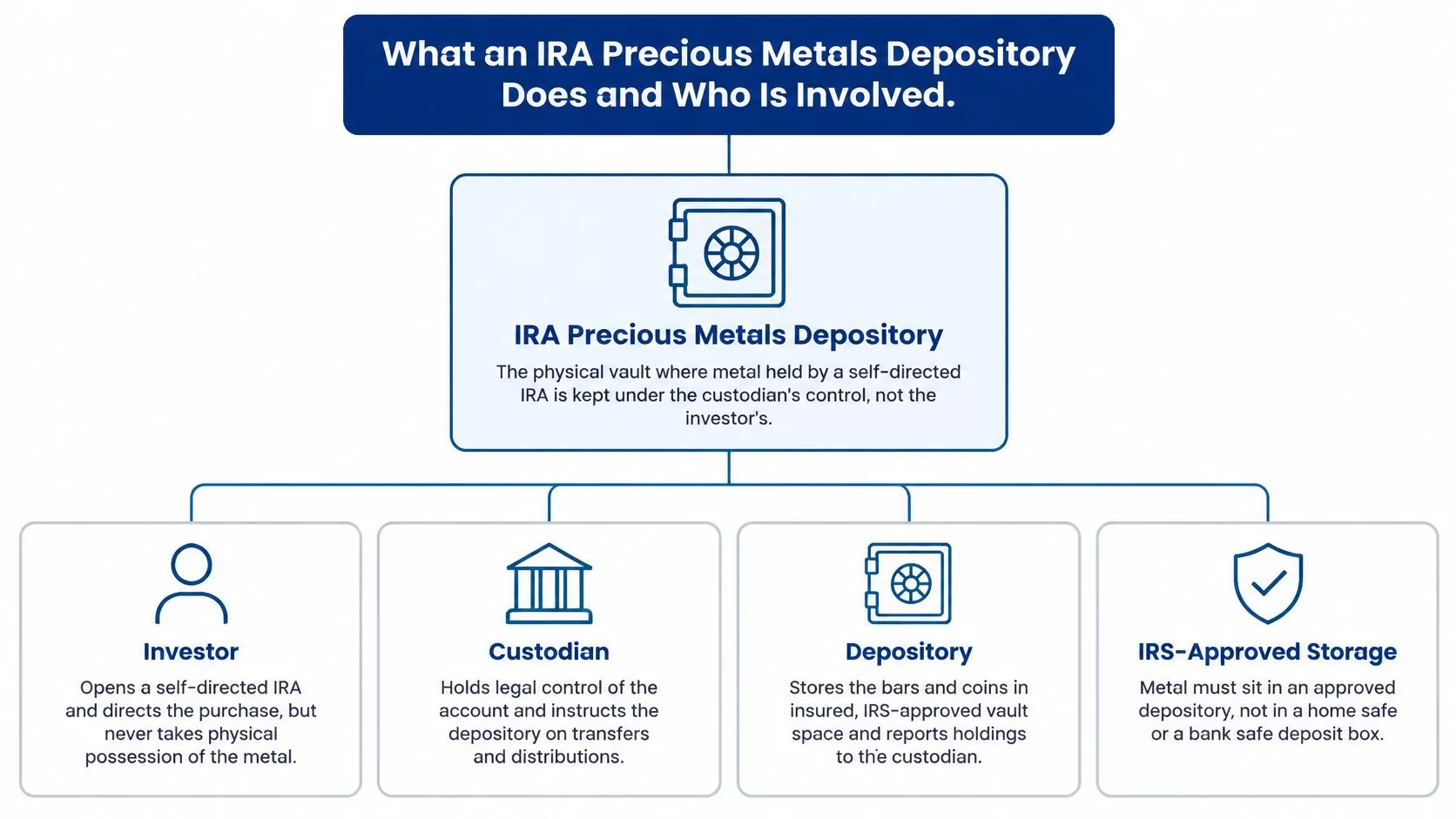
From there, the parties line up in a hierarchy with the custodian at the top.
- The IRA owner chooses the metal and signs the transaction instructions, but never takes possession of it.
- The IRA custodian or trustee holds legal control of the account and its assets, processes authorized transactions, and handles reporting. The guide to IRA custodian responsibilities covers how far that role reaches.
- The depository or vault operator receives the bars and coins, stores them in insured space, and reports the holdings back to the custodian.
- The insurer covers defined physical losses under a policy whose terms are usually arranged at the depository or custodian level, not by the account owner.
- The independent auditor, where one is used, checks that the recorded inventory matches what is in the vault.
The chain of command: the custodian holds legal control, the depository holds the metal, and the insurer covers defined losses. Remove any one of the three and the arrangement stops working.
Two confusions are worth clearing up immediately. A depository is not the dealer that sold you the coins, and it is not a bank deposit. Metal in a vault is not covered by federal deposit insurance, and a prestigious vault name is not a guarantee against documentation or counterparty problems. The depository is one link, and every link has its own paperwork you should request and keep.
Why IRA Metal Cannot Be Stored at Home
The rule that makes home storage a problem is short. When the account owner takes physical possession of qualifying coins or bullion, the IRS can treat that metal as a distribution, which removes the tax-advantaged treatment the account was built for. The IRS retirement plan FAQs on IRAs describe the requirement that bullion remain in the physical possession of an IRA trustee or custodian, and recognize separate vault services only where the arrangement preserves the trustee's legally recognized possession and oversight.
That is why the depository matters beyond security. It is the control point that keeps the metal inside the custody structure rather than in your hands.
| Factor | Home Storage | Depository Under Custodian Control |
|---|---|---|
| Tax eligibility | Owner possession can be treated as a distribution | Metal remains in trustee or custodian possession |
| Who holds the metal | The account owner | The vault operator, for the IRA custodian |
| Records | Personal receipts and notes | Custodian statements and inventory reconciliation |
| Insurance | Often a separate policy with its own limits | Coverage arranged under the custodian or depository agreement, with terms that vary by provider |
| Access | Owner at any time | Withdrawals follow the custodian's distribution instructions |
| Audit | Self-verified | Independent audit where the provider offers one |
A typical home arrangement looks reasonable on paper. There's a bolted safe, a homeowners rider with a sublimit for valuables, and a folder of purchase receipts. None of those elements creates custodial possession, and none of them produces the records a custodian would need to reconcile an IRA holding against an order.
Keep one distinction straight. Metal you bought outside an IRA and keep at home is a separate question with separate rules. The custody requirement bites because of the tax wrapper, not because home storage is unsafe.
If IRA metal is already at home, contact the custodian before moving, selling, or re-depositing anything. Don't assume the treatment of that metal is unaffected by the time it spent in your possession.
Which Metals an IRA Depository Can Hold
A metal's market value or brand name does not make it eligible. IRS Publication 590-B lists the examples the agency points to: eligible U.S. gold coins include one-ounce, one-half-ounce, one-quarter-ounce, and one-tenth-ounce coins minted by the Treasury Department, and eligible U.S. silver coins include one-ounce Treasury-minted coins. The publication also permits certain platinum coins and certain gold, silver, palladium, and platinum bullion. The word "certain" is doing real work in that sentence.
| Product | Due-diligence note |
|---|---|
| Gold bullion bars | Refiner must be one the custodian accepts |
| American Eagle gold coins | Treasury-minted; 1 oz, 1/2 oz, 1/4 oz and 1/10 oz |
| American Eagle silver coins | Treasury-minted; 1 oz only |
| Silver bullion | Must match the custodian's approved list |
| Platinum bullion and certain coins | Only products listed as eligible |
| Palladium bullion | Only products listed as eligible |
How to check a product before you buy
Every category carries a minimum fineness threshold, and the account's approved-product list is where those thresholds live for your specific account. A round, bar, or commemorative piece that looks like bullion to a buyer may fail the statutory eligibility test entirely, and no amount of vault security cures an ineligible product.
Work through three steps before any order is placed.
- Match the item against the custodian's approved list. Not the dealer's catalog, and not a competitor's list. The custodian's own document is what governs.
- Record the identifiers. Note the exact weight, the fineness, the refiner or mint name, and the serial number where the bar carries one.
- Confirm the receiving process keeps them. Ask how the depository records incoming metal so those identifiers survive from the dealer's shipment to your statement.
Eligible product lists change over time as mints issue new coins and custodians revise what they accept. Verify each item against current IRS publications before purchase rather than relying on a list you saved years ago. The overview of precious metals types is a useful starting point for comparing categories before you talk to a custodian.
Segregated or Commingled Storage and What Insurance Covers
Who can open the vault, and on whose written instruction, matters more than the thickness of the door.

The legal custodian is the IRA trustee. It keeps the account records and is the party recognized as holding the assets. The vault operator stores the metal and moves it only on the custodian's instructions. The insurer responds to specified physical losses, usually for the depository or the custodian, not for you as a personal payee. A thick door does not turn the vault company into your custodian.
Segregated storage keeps each item identified by serial number or assay certificate, so the exact bar or coin can be returned on distribution. It works like a coat check: the ticket matches one coat. Commingled storage pools metal with other holdings of the same type and purity, and the IRA owns a proportional claim against that pool. Segregated costs more and suits unique or large holdings. Commingled is the standard, lower-cost route for ordinary bullion.
The practical question isn't which label sounds safer. It's whether the custodian's records can reconcile purchases, transfers, and distributions to the IRA's stated holdings. IRS materials identify 0.995 fineness, 995 parts per 1,000, as the benchmark for gold bullion tied to regulated futures-delivery standards, in the IRS guidance on collectibles in individually directed accounts. Storage can't fix a product that never qualified.
Insurance is where the most assumptions go unchecked. A policy may address theft, employee dishonesty, transit loss, and natural catastrophe. Ask about exclusions, deductibles, the named payee, and whether a claim is paid to the IRA or to the account owner. Insurance replaces missing metal. A fall in market price stays with the investor.
Request three documents before you commit: the custody agreement, the insurance certificate, and the most recent audit summary. Then ask for the full fee schedule in writing, because storage, handling, administration, and insurance charges can materially raise the total cost of holding metal in an IRA. Compare the annual all-in cost across providers rather than a single line item.
Depository Checklist to Verify Before You Commit
Run this checklist against the provider's actual documents, not its marketing pages. Ask for each answer in writing, and treat an unwillingness to supply a document as an answer in itself.
| Check | Good Answer Looks Like | Red Flag |
|---|---|---|
| Legal custodian | Named in the account agreement and approved to act as an IRA trustee or custodian | No custodian named, or the vault operator presented as the IRA holder |
| Physical vault operator | Identified with its location and a written arrangement with the custodian | Location or operator kept undisclosed |
| Storage type | Segregated or commingled, stated clearly with ownership terms | Vague wording such as all metal is secure |
| Inventory records | Reconciliation of purchases, transfers and distributions to IRA holdings | Records available only as summary totals |
| Independent audit | Auditor named, audit frequency stated, report available on request | No audit, or audit results withheld |
| Insurance | Covers theft, employee dishonesty, transit and natural catastrophe, certificate provided | Refusal to provide the certificate, or an unclear claim payee |
| Distribution procedure | Written steps, with the custodian's instructions required | Requests to take physical possession of metal |
| Complaint history | Checked in regulator databases and reviewed against the provider's own statements | Unexplained complaints, or no regulatory record found |
Where the checklist stops
This list confirms custody and administration. It does not confirm that the metal is a good investment, fairly priced, or even what the seller says it is. Self-directed IRA custodians generally do not verify the quality, value, or legitimacy of the underlying asset, and they don't investigate the promoter behind it. The CFTC advisory on precious metals makes the same point from the regulator's side: these accounts may carry only limited investor protections, while storage, handling, administration, and insurance charges can materially increase costs.
A prestigious vault name does not eliminate counterparty risk. Compliance with the custody rule addresses possession. It says nothing about whether you paid a fair premium.
Third-party verification has limits of its own. Gold IRA Association states plainly that it has not reviewed all sites linked from its website and is not responsible for their contents, which is a fair reminder that a link, a mention, or a review quote is not a substitute for pulling the custody agreement and the insurance certificate yourself.
Mistakes That Turn IRA Metal Into a Taxable Distribution
Take an illustrative case. A 52-year-old holds a traditional IRA and directs a $20,000 purchase of collectible coins that don't meet the statutory exception. The tax problem doesn't wait for a sale. The invested amount is treated as distributed in the year of the investment, which can create ordinary income for a traditional IRA. Because the owner is under 59½, the 10% additional tax on early distributions may also apply, subject to the usual exceptions described in IRS Publication 590-A.
The second mistake is quieter. The owner buys qualifying coins, then takes delivery because it feels safer to hold them. Taking possession can produce the same distribution result, and the metal that was supposed to sit inside a tax-advantaged account ends up outside it. At this point the custody chain from earlier in the guide stops being paperwork and starts being protection: possession by anyone other than the custodian's depository is exactly what the rule prohibits.
Two habits cover most of the risk.
- Clear the product before ordering. Use the approval steps from the metals section above: match the item against the custodian's approved list and record weight, fineness, and refiner before any money moves.
- Read the paper trail if anything leaves the account. A distribution is not invisible. The custodian reports it on Form 1099-R, which shows the gross amount distributed and how much of it is taxable. If metal ever moves out of the depository on your instructions, expect that form for the year it happened and compare it against your own records before filing.
The consequences depend on your individual circumstances, and the example above is illustrative, not a prediction. The tax compliance requirements for precious metals accounts go deeper into how these rules interact with account types and reporting.
Frequently Asked Questions About IRA Precious Metals Depositories
How should I read a custodian statement?
The statement works like a title. The vault log works like a warehouse receipt. Match the account name (the custodian for the IRA, not your own name), the metal, the weight, and the site. This period should equal the last one after buys and releases.
What should I ask if the vault operator changes?
Ask in writing for the new firm's legal name, proof the same custodian still controls the metal, a count at the handoff, and whether coverage continues in transit. A new building leaves legal custody where it was.
Who do I contact if those records disagree?
Start with the custodian. They hold your instructions. The vault operator explains a receipt or a release. The insurer answers a covered physical loss for the named insured, often not you personally.
What does the depository protect, and what stays with me?
It protects the building and the count. The custodian protects legal custody. A price drop stays with you. Locks do not cover the market.
Confirm Depository Terms Before You Fund an Account
Funding an account before the custody chain is clear creates avoidable confusion. The IRA custodian, the vault operator, and any insurance protection do different jobs, like a bank, a warehouse, and a policy document. The account owner needs to know who directs the metal, where it is held, and what records connect the IRA to specific holdings.
A short pre-funding review can prevent larger problems later. Confirm that the custody agreement names the IRA custodian and explains its authority over the metal. Match the vault operator, storage type, insurance terms, and fee schedule to the written information you have gathered. Then retain statements and inventory reconciliations, since those records show how the account was administered over time.
Readers who want to talk through account rules and provider comparisons can call 888-910-8386, or send a direct message to Gold IRA Association for help locating educational information.
Risk note: investing in precious metals and IRAs involves risk, including the potential loss of principal.
The materials on this website are provided for informational purposes only and are not intended as financial, legal, or investment advice. Consult a licensed financial advisor, CPA, or tax professional before making investment decisions.
Gold IRA Association publishes educational guides on custody, eligible metals, and depository due diligence. The resources at Gold IRA Association can help readers locate that information before comparing account documents.